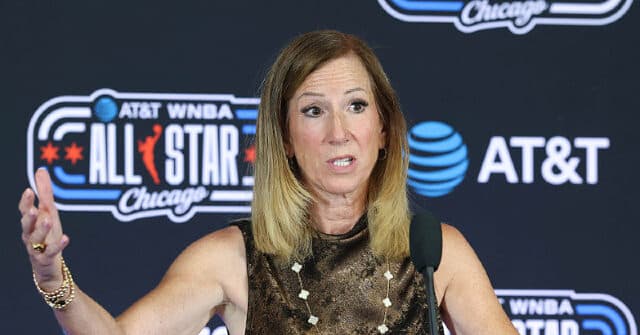
WNBA Commissioner Exits Amid Transgender Eligibility Firestorm
Left says
- •Engelbert's departure caps a seven-year tenure that delivered record revenue, a landmark collective bargaining agreement with the league's first million-dollar salaries, a long-term media rights deal, and franchise expansion.
- •Engelbert and NBA commissioner Adam Silver frame the exit as a planned, voluntary transition rather than a forced resignation, with Engelbert stating she was not pressured by league or team stakeholders.
- •The league maintains there are no current eligibility issues regarding transgender athletes in the WNBA, suggesting the controversy has been amplified disproportionately relative to any actual on-court impact.
- •Players have faced significant online hate and harassment throughout this debate, a concern the league says it will continue to address alongside broader stakeholder discussions.
Right says
- •Engelbert's 'retirement' is widely viewed as a euphemism for being pushed out after mishandling the league's failure to clearly define who qualifies as a woman for competition.
- •Her leadership drew criticism for what many saw as inadequate protection and promotion of star player Caitlin Clark, including a perceived light punishment after an on-court altercation involving Clark.
- •A league meeting convened specifically to define 'woman' for eligibility purposes ended without any resolution, exposing a lack of decisive leadership on the issue.
- •Some commentators argue the league's growth and revenue gains are attributable primarily to Caitlin Clark's popularity rather than Engelbert's stewardship, and figures like Enes Kanter Freedom have proposed themselves as replacements to restore clear sex-based eligibility rules.
Common Take
High Consensus- Cathy Engelbert served as WNBA commissioner for over seven years, becoming the first person to hold that title, and is retiring at the end of 2026.
- Her tenure coincided with significant league growth, including a new collective bargaining agreement, a long-term media rights deal, and franchise expansion.
- The debate over transgender athlete eligibility in the WNBA remained unresolved and contentious throughout the year, including a stakeholder meeting that ended without a clear definition of eligibility criteria.
- Adam Silver publicly praised Engelbert's leadership and the league's growth under her tenure in the official announcement.
The Arguments
Left argues
Engelbert's tenure delivered concrete, measurable wins for players and the league: a landmark CBA with the first million-dollar salaries, a long-term media rights deal, franchise expansion, and record revenue and viewership — a legacy that stands independent of the current controversy.
Right counters
Impressive topline numbers don't prove good stewardship if the growth is attributable to a single generational player, Caitlin Clark, whose popularity coincided with but wasn't necessarily caused by Engelbert's leadership decisions.
Right argues
A commissioner who convenes a meeting specifically to define who is eligible to compete as a woman and walks away with no answer has failed at a core governance function, especially when that ambiguity is actively being exploited by high-profile provocateurs seeking to enter the league.
Left counters
The league states there are no current eligibility cases actually pending in the WNBA, meaning the 'firestorm' is a hypothetical and media-driven controversy rather than a real on-court crisis demanding an immediate policy overhaul.
Right argues
The perceived light punishment for the on-court altercation involving Caitlin Clark, combined with the league's broader reluctance to center and protect its biggest draw, suggests a leadership more focused on managing optics than on substantive player safety and promotion decisions.
Left counters
Disciplinary decisions in physical, competitive sports are inherently contentious and subjective, and reducing a commissioner's entire tenure to one contested suspension call ignores the far larger structural achievements of her seven years in charge.
Left argues
Both Engelbert and Adam Silver, the NBA commissioner with direct oversight, have explicitly and consistently characterized this as a voluntary, long-planned transition rather than a forced ouster, and there is no verified evidence contradicting their account.
Right counters
Corporate 'retirements' timed precisely to the peak of public controversy over a leader's job performance are a well-worn euphemism for a forced exit, and the framing itself deserves skepticism rather than automatic acceptance.
Left argues
The league has flagged that players are enduring significant online hate and harassment throughout this debate, indicating the controversy carries real human costs for athletes that the 'define a woman' framing obscures or ignores.
Right counters
Acknowledging harassment as a talking point does not substitute for the substantive rule-making players and fans are actually asking for; sympathy statements without clear eligibility standards leave the underlying fairness question completely unresolved.
Challenge Questions
These questions target genuine internal contradictions — meant to provoke honest reflection.
Right asks Left
“If there are truly no current eligibility issues in the WNBA, why did league leadership convene a dedicated meeting to try to define what qualifies someone as a woman for competition, and why did that meeting produce no resolution?”
Left asks Right
“If Engelbert's leadership is primarily to blame for the league's problems, how do you reconcile that with crediting her tenure's growth almost entirely to Caitlin Clark rather than to any structural decisions the commissioner's office made?”
Outlier Report
Left Fringe
Progressive commentators and some WNBA players' advocacy voices (e.g., those aligned with athlete-activist statements) who argue the entire controversy is manufactured/amplified harassment with no real eligibility issue; roughly 15-20% of the left holds this more absolutist framing versus the more moderate 'mixed legacy' view in the synopsis.
Right Fringe
Figures like Enes Kanter Freedom and Dave Portnoy represent an extreme, performative fringe calling for stunt candidacies or mocking framing ('Make WNBA Female Again'); this represents maybe 10-15% of the right, with most conservatives holding the more measured 'she mishandled the issue' view rather than the theatrical takes.
Noise Assessment
Substantial portion of right-wing coverage (Kanter's mock candidacy, Portnoy tweets, RedState's satirical tone) is performative content amplified by online engagement rather than reflecting how most Americans actually feel about a sports league commissioner transition; likewise, left coverage downplaying the controversy may understate genuine public concern about the eligibility debate.
Sources (9)
<p>The WNBA has announced that league commissioner Cathy Engelbert will retire at the end of her contract this year.</p> <p>The post <a href="https://www.breitbart.com/sports/2026/09/04/embattled-wnba-commissioner-cathy-engelbert-retire-end-year/" rel="nofollow">Embattled WNBA Commissioner Cathy Engelbert to Retire at the End of the Year</a> appeared first on <a href="https://www.breitbart.com" rel="nofollow">Breitbart</a>.</p>
Cathy Engelbert announced that she will step down as WNBA commissioner at the end of the calendar year as the league remains mired in controversy over transgender participation in women’s sports. Engelbert told the Associated Press in an interview that she was not pressured to step down by the NBA or WNBA stakeholders, saying the ...
Sullivan initially declared his intent to declare a mistrial on Friday morning, but walked back those plans to allow defense attorney Kevin Reddington to petition the higher court for intervention, which was denied on Friday.
<ul><li><p>Seven-year tenure included both growth and tumult</p></li><li><p>Internal and external candidates are on league’s radar</p></li><li><p><a href="https://www.theguardian.com/sport/2026/sep/04/cathy-engelbert-wnba-commissioner-wins-losses-retirement">Analysis: Cathy Engelbert’s defining wins and losses</a></p></li></ul><p>WNBA commissioner Cathy Engelbert is retiring at the end of the year, bringing to a close her seven-plus years at the helm of the league and a stewardship that has been transformative and at times tumultuous.</p><p>Engelbert is the second-longest tenured WNBA president or commissioner, and she helped negotiate a lucrative collective bargaining agreement this past spring that resulted in the league’s first set of million-dollar player salaries.</p> <a href="https://www.theguardian.com/sport/2026/sep/04/wnba-commissioner-cathy-engelbert-to-retire">Continue reading...</a>
Englebert has presided over expansion, but has been criticized for the league's handling of Caitlin Clark and trans policies.