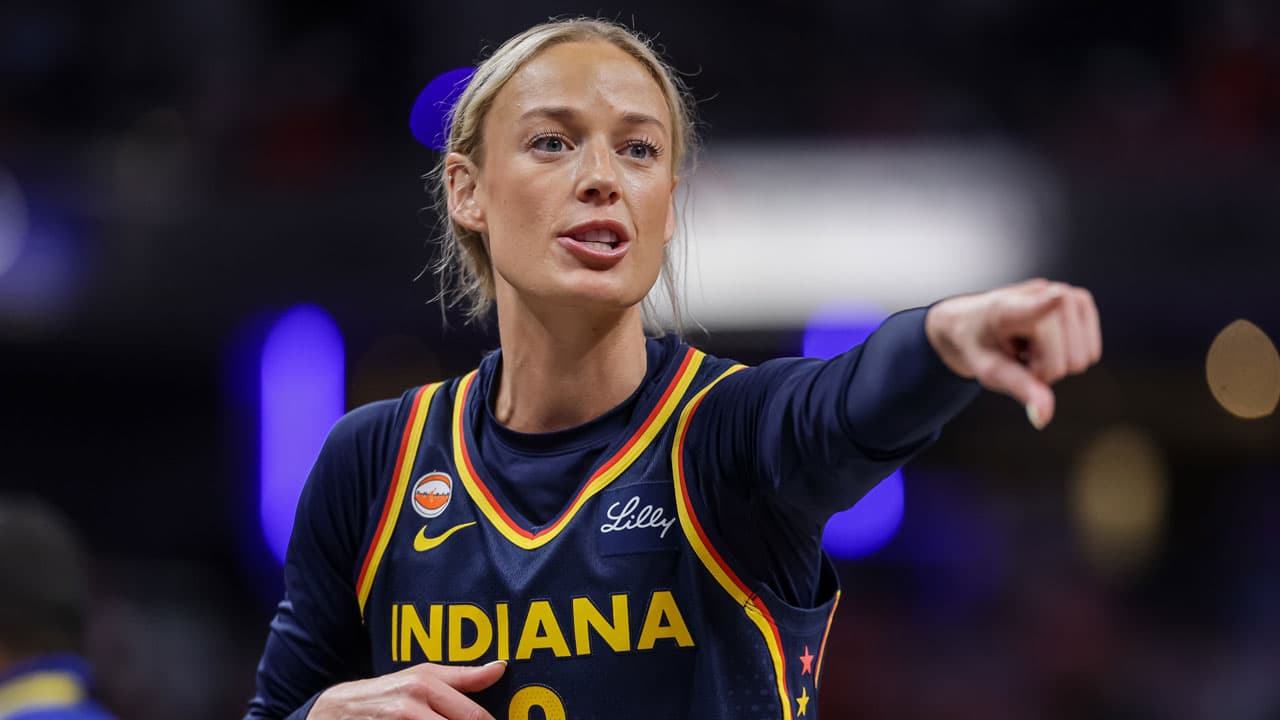
 Sophie Cunningham of the Indiana Fever pointing during a game.
WNBA Star's Anti-Trans Sports Stance Sparks Backlash, White House Backing
Left says
- •Critics describe Cunningham's comments as invoking a well-worn talking point that frames transgender people, particularly transgender girls and women, as threats rather than as a small and already marginalized group.
- •Journalists and advocates argue that repeating this framing publicly, especially from a high-profile athlete, contributes to real-world harm against transgender youth even if Cunningham does not personally intend hostility.
- •Some critics see the White House's rapid embrace of Cunningham's remarks as evidence that the administration is using her platform to advance a broader political agenda against transgender rights.
- •Advocates like Megan Rapinoe contend that excluding transgender athletes under the banner of protecting women's sports misrepresents the actual scale and nature of the issue.
Right says
- •Supporters view Cunningham's remarks as a straightforward, common-sense defense of fairness and safety for female athletes rather than an attack on transgender people.
- •They point to polling suggesting roughly 80 percent of Americans oppose transgender participation in women's sports, framing the backlash as coming from an out-of-touch activist minority.
- •Cunningham's refusal to apologize or walk back her comments is celebrated as a rejection of cancel-culture pressure tactics that have historically forced public figures into contrition.
- •Some commentators highlight her subsequent exclusion from the WNBA's 3-point contest as evidence of retaliation against her for expressing a mainstream viewpoint.
Common Take
- Cunningham told ESPN she wants to protect young girls in locker rooms and sports from competing against biological men.
- She has stated she does not view her position as motivated by hatred toward transgender people and describes it as rooted in honesty and personal morals rather than partisan politics.
- The White House, through Press Secretary Karoline Leavitt, publicly backed Cunningham's position, calling it reflective of widespread public opinion.
- The comments have sparked significant public debate, drawing both strong criticism from advocates and journalists and strong support from conservative commentators and officials.
The Arguments
Right argues
Cunningham's position reflects a common-sense concern for fairness and safety in women's sports, and polling showing roughly 80 percent public agreement suggests she is voicing a mainstream view rather than an extreme one.
Left counters
Broad polling on a general principle doesn't capture the nuance of how few transgender athletes actually compete or the real-world harm that sweeping rhetoric can cause to a small, already marginalized group.
Left argues
Critics argue that framing transgender women and girls as a threat to be 'protected against' relies on a well-worn talking point that exaggerates the scale of the issue and stigmatizes an entire group based on the actions of a few.
Right counters
Cunningham explicitly denies hostility toward transgender people and frames her comments as being about biological fairness and safety, not an attack on anyone's identity or worth.
Right argues
Cunningham's refusal to apologize or walk back her comments, encapsulated in 'I said what I said,' is celebrated as a healthy pushback against cancel-culture dynamics that have historically pressured public figures into forced contrition.
Left counters
Refusing to apologize doesn't make a claim accurate or harmless; standing firm on a position doesn't shield it from legitimate criticism about its real-world effects on transgender youth.
Left argues
The White House's rapid, enthusiastic embrace of Cunningham's remarks suggests the administration is leveraging her platform and popularity to advance a broader political agenda against transgender rights, beyond the narrow question of sports fairness.
Right counters
The administration is simply reflecting a widely held public position on a specific policy question; engaging with a high-profile, timely news story is standard practice for a press secretary, not evidence of a hidden agenda.
Right argues
Cunningham's exclusion from the WNBA's 3-point contest, despite her strong shooting statistics, is cited as evidence that she faced professional retaliation for expressing a mainstream viewpoint rather than a purely basketball-based decision.
Left counters
Roster and event selections in professional sports involve many subjective factors, and attributing a single exclusion to political retaliation without direct evidence risks over-reading a routine competitive decision.
Challenge Questions
These questions target genuine internal contradictions — meant to provoke honest reflection.
Right asks Left
“If Cunningham explicitly states she doesn't hate transgender people and frames her stance as being about biological fairness, on what basis do critics conclude her intent or effect is inherently transphobic rather than a genuine, if contestable, policy disagreement?”
Left asks Right
“If the concern is genuinely about protecting 'young girls' broadly, how does citing an 80-20 poll on a complex, evolving issue address the specific fairness and safety questions at stake, rather than simply asserting popularity as proof of correctness?”
Outlier Report
Left Fringe
Journalists like Roberta F. Rodrigues and Christan Braswell who label Cunningham's comments as outright transphobic represent a vocal activist-journalist segment, roughly 15-20% of the left, that dominates social media discourse but not necessarily mainstream Democratic opinion.
Right Fringe
Commentators framing this in racialized or culture-war terms beyond the sports issue (e.g., Washington Free Beacon's framing invoking 'attractive white women' and DEI) represent a smaller, more provocative fringe, roughly 10-15% of the right, that uses the story to score broader ideological points rather than focus narrowly on fairness in sports.
Noise Assessment
High noise ratio: the intensity of social media backlash and White House amplification substantially outweighs the actual proportion of Americans who feel strongly enough to organize around this specific incident; most Americans likely agree with the general fairness argument without engaging in the culture-war framing on either side.
Sources (7)
Perspective: The subtext was clear to her aspirant cancelers: I hear you, I see you, and I don’t care. This is 2026, not 2016.
The White House came to the defense of WNBA star Sophie Cunningham Thursday after the Indiana Fever guard faced criticism for saying that men should not compete in women’s sports or share women’s locker rooms. When asked about the issue by Daily Wire White House Correspondent Mary Margaret Olohan, White House Press Secretary Karoline Leavitt ...
<p>"I want to protect young girls in a locker room, or young girls in sport who shouldn't have to go against biological men."</p> The post <a href="https://legalinsurrection.com/2026/07/i-said-what-i-said-sophie-cunningham-stands-by-position-opposing-men-in-womens-sports/">‘I Said What I Said’: Sophie Cunningham Stands by Position Opposing Men in Women’s Sports</a> first appeared on <a href="https://legalinsurrection.com">Le·gal In·sur·rec·tion</a>.
The WNBA star states the obvious about men playing women’s sports under the guise of inclusivity. <img src="https://i0.wp.com/www.nationalreview.com/wp-content/uploads/2026/07/sophie-cunningham.jpg?fit=617%2C360&ssl=1" />
Indiana Fever star Sophie Cunningham defended the policy of keeping men out of women’s sports and girls’ locker rooms this week, and the Left and media immediately screamed, “Foul!” However, Cunningham characteristically refused to back down and on Wednesday night repeated her desire to protect girls in sports. The WNBA star, whose fierce, hysterical 22-second...
<p>Sophie Cunningham is one of the most talented players in the WNBA. In a sport where attractive white women have long been marginalized and underrepresented, the Indiana Fever guard has repeatedly defied the odds to become the superstar she is today. Her success is a powerful testament to the value of diversity, equity, and inclusion.</p> <p>The post <a href="https://freebeacon.com/culture/meet-sophie-cunningham-the-wnba-superstar-and-scrappy-feminist-standing-up-for-womens-sports/">Meet Sophie Cunningham, the WNBA Superstar and Scrappy Feminist Standing Up for Women's Sports</a> appeared first on <a href="https://freebeacon.com"></a>.</p>
KAROLINE LEAVITT defends WNBA player Sophie Cunningham, who said biological men should not play in women's sports: "Men should not be playing in women's sports. It's completely ludicrous that anyone could support that ... The backlash she is receiving from Democrats and left-wing figures across the country is astonishing. They are clearly very out of touch with the American public on this issue..."