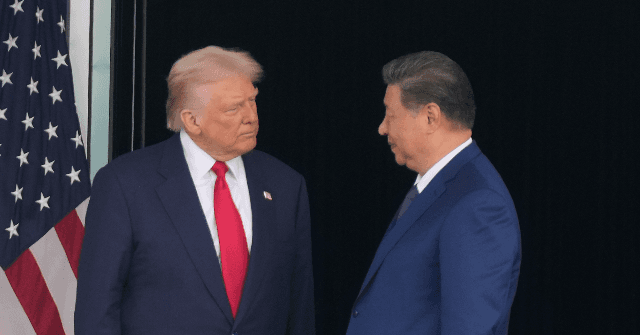
Xi Warns Trump of 'Clash' Over Taiwan During Beijing Summit
Left says
- •Xi's warning about potential conflict over Taiwan represents a dangerous escalation that could destabilize the region and threaten global peace
- •Trump's deferential tone and praise for Xi as a 'great leader' undermines America's commitment to democratic allies like Taiwan
- •The summit prioritizes economic deals and business interests over human rights concerns and democratic values in the region
- •China's aggressive stance on Taiwan threatens the self-determination of 23 million Taiwanese people who live in a functioning democracy
Right says
- •Trump's diplomatic engagement with Xi demonstrates strong leadership in managing the world's most important bilateral relationship
- •The summit produced concrete wins including agreements on fentanyl precursors, American oil purchases, and agricultural trade that benefit American workers
- •Trump's business-focused approach with top CEOs present shows his commitment to creating economic opportunities for Americans
- •Maintaining dialogue with China is essential for addressing global challenges like the Iran conflict and preventing military confrontation
Common Take
High Consensus- The US-China relationship is the most important bilateral relationship in the world with global implications
- Both leaders agree that cooperation benefits both countries while confrontation harms both sides
- The summit addressed critical issues including trade, Iran, and regional stability that affect global markets
- Taiwan remains the most sensitive and potentially dangerous flashpoint in US-China relations
The Arguments
Right argues
Trump's diplomatic engagement with Xi demonstrates strong leadership by maintaining dialogue with the world's most important bilateral relationship, producing concrete wins like agreements on fentanyl precursors, American oil purchases, and agricultural trade that directly benefit American workers and businesses.
Left counters
Trump's deferential tone, calling Xi a 'great leader' and saying 'it's an honor to be your friend,' undermines America's credibility with democratic allies and sends the wrong signal about authoritarian leadership while Xi simultaneously threatens military conflict over Taiwan.
Left argues
Xi's warning that the two countries could 'clash or even come into conflict' over Taiwan represents a dangerous escalation that threatens the self-determination of 23 million Taiwanese people living in a functioning democracy and destabilizes regional peace.
Right counters
Maintaining open diplomatic channels is precisely how nations prevent military confrontation - Trump's willingness to engage directly with Xi creates opportunities to manage tensions and find peaceful solutions rather than allowing conflicts to escalate through isolation.
Right argues
The summit's business-focused approach, bringing top CEOs like Tim Cook and Elon Musk, demonstrates Trump's commitment to creating economic opportunities for Americans through expanded market access and trade agreements that strengthen the U.S. economy.
Left counters
Prioritizing business deals and economic interests over human rights concerns and democratic values sends the message that America's principles are negotiable, weakening our moral authority and abandoning our commitment to supporting democracy worldwide.
Left argues
The summit's emphasis on economic cooperation while downplaying Taiwan's democratic status legitimizes China's authoritarian claims and undermines decades of U.S. policy supporting democratic allies in the face of authoritarian expansion.
Right counters
Pragmatic diplomacy requires engaging with major powers on multiple fronts - economic cooperation can create interdependencies that actually reduce the likelihood of military conflict while providing leverage to address security concerns through negotiation rather than confrontation.
Challenge Questions
These questions target genuine internal contradictions — meant to provoke honest reflection.
Right asks Left
“If diplomatic isolation and confrontational rhetoric are more effective than engagement, why haven't decades of such approaches successfully deterred China's growing assertiveness, and how does refusing dialogue make Taiwan or other democratic allies actually safer?”
Left asks Right
“If economic partnerships and friendly rhetoric with authoritarian leaders are truly effective diplomatic tools, why do these relationships consistently fail to moderate authoritarian behavior, and how do you reconcile praising Xi as a 'great leader' with his regime's human rights record and threats against democratic Taiwan?”
Outlier Report
Left Fringe
Progressive foreign policy activists like CodePink's Medea Benjamin and some Squad members who might argue for complete disengagement from China represent about 15% of the left. Anti-war voices who see any summit as legitimizing authoritarianism.
Right Fringe
Hardline China hawks like Senator Tom Cotton and former Trump advisor Steve Bannon who view any diplomatic engagement as weakness represent about 20% of the right. They prefer maximum confrontation over economic cooperation.
Noise Assessment
Moderate noise level - most coverage focuses on substantive policy outcomes rather than performative outrage, though some amplification occurs around Taiwan rhetoric and Trump's praise of Xi.
Sources (16)
<p>President Donald Trump meets with Chinese President Xi Jinping in Beijing on Wednesday, May 13.</p> <p>The post <a href="https://www.breitbart.com/asia/2026/05/13/watch-live-donald-trump-meets-with-xi-jinping-in-china/" rel="nofollow">Watch Live: Donald Trump Meets with Xi Jinping in China</a> appeared first on <a href="https://www.breitbart.com" rel="nofollow">Breitbart</a>.</p>
The greeting, which will take place 10 a.m. local time, kicks off the summit, which will include talks about sanctions on Iranian oil and the conflict in the Middle East at large.
The president was initially supposed to meet Chinese President Xi Jinping earlier this year but the summit was postponed because of the Iranian conflict, which still hovers over the meeting.
President Trump and Chinese President Xi Jinping shake hands, participating in a ceremony at the Great Hall of the People ahead of their bilateral talks.
Chinese President Xi Jinping began the talks with President Donald Trump by emphasizing that the world is watching and is “at a new crossroads.”
President Trump and Chinese President Xi meet at the Great Hall of the People in Beijing. NBC News' Janis Mackey Frayer explains the significance of the meeting place and welcoming ceremony.
An expert told Newsweek that the interaction included: "features of power-play."
<p>Security was heightened in Beijing ahead of the two leaders’ crucial talks, where they discussed economic cooperation, trade and Iran</p><ul><li><p><a href="https://www.theguardian.com/world/2026/may/13/trump-china-summit-xi-jinping-talks">Trump lands in China for high-stakes summit with Xi Jinping as Iran war looms over talks</a></p></li><li><p><a href="https://www.theguardian.com/world/2026/may/13/donald-trump-china-sumit-5-key-issues-xi-jinping">Explainer: five key issues on the table at summit</a></p></li><li><p><a href="https://www.theguardian.com/news/2026/feb/17/sign-up-for-the-breaking-news-us-email-to-get-newsletter-alerts-direct-to-your-inbox?utm_medium=ACQUISITIONS_STANDFIRST&utm_campaign=BN22326&utm_content=signup&utm_term=standfirst&utm_source=GUARDIAN_WEB">Sign up for the Breaking News US email</a><br /></p></li></ul><p><strong>Donald Trump will drive through a Chinese capital that is smoggier than it was on his last visit in 2017</strong>, when the authorities launched emergency measures to clear the skies of pollution days before his first state visit to Beijing.</p><p>Factories were ordered to halt production and heavily polluting cars were banned from the roads in the days ahead of the US president’s trip nearly a decade ago, an era in which China had declared war on air pollution and made special efforts to clear the skies ahead of important political events such as visiting dignitaries and the Beijing Olympics.</p> <a href="https://www.theguardian.com/us-news/live/2026/may/14/donald-trump-china-xi-jinping-live-updates-talks-meeting-summit-visit-beijing-latest-news">Continue reading...</a>
<p>Trump is meeting Xi in Beijing, with the two superpower leaders expected to discuss the Iran war, trade, Taiwan and artificial intelligence</p> <a href="https://www.theguardian.com/world/gallery/2026/may/14/donald-trump-meets-xi-jinping-china-summit-in-pictures">Continue reading...</a>
Chinese President Xi Jinping warned President Trump about tensions between Washington and Beijing over Taiwan during their first meeting in Beijing on Thursday, according to China’s Foreign Ministry. “Safeguarding peace and stability across the Taiwan Strait is the biggest common denominator between China and the U.S.,” Xi told Trump, according to a post on social platform…
President Trump praised Chinese President Xi Jinping during their bilateral meeting in Beijing on Thursday, telling the leader, “It’s an honor to be your friend.” “There are those that say this is the biggest summit ever,” Trump told Xi during the public portion of their bilateral meeting. “They can never remember anything like it. I can…
Chinese President Xi Jinping warned President Trump about tensions between Washington and Beijing over Taiwan during their bilateral meeting on Thursday, according to China’s Foreign Ministry. “Safeguarding peace and stability across the Taiwan Strait is the biggest common denominator between China and the U.S.,” Xi told Trump, according to a post on social platform X…
President Trump signaled in his opening remarks at the bilateral meeting in Beijing on Thursday local time that he wants to do business with China and emphasized his friendship with Chinese President Xi Jinping. He boasted about the size of the delegation he brought, which included prominent executives like Apple’s Tim Cook, Tesla and SpaceX’s…
China's Xi Jinping warned President Trump on Thursday that the two countries could clash over Taiwan if the issue was not handled properly, an unusually harsh admonition that stood in contrast to the American leader's praise for his counterpart.