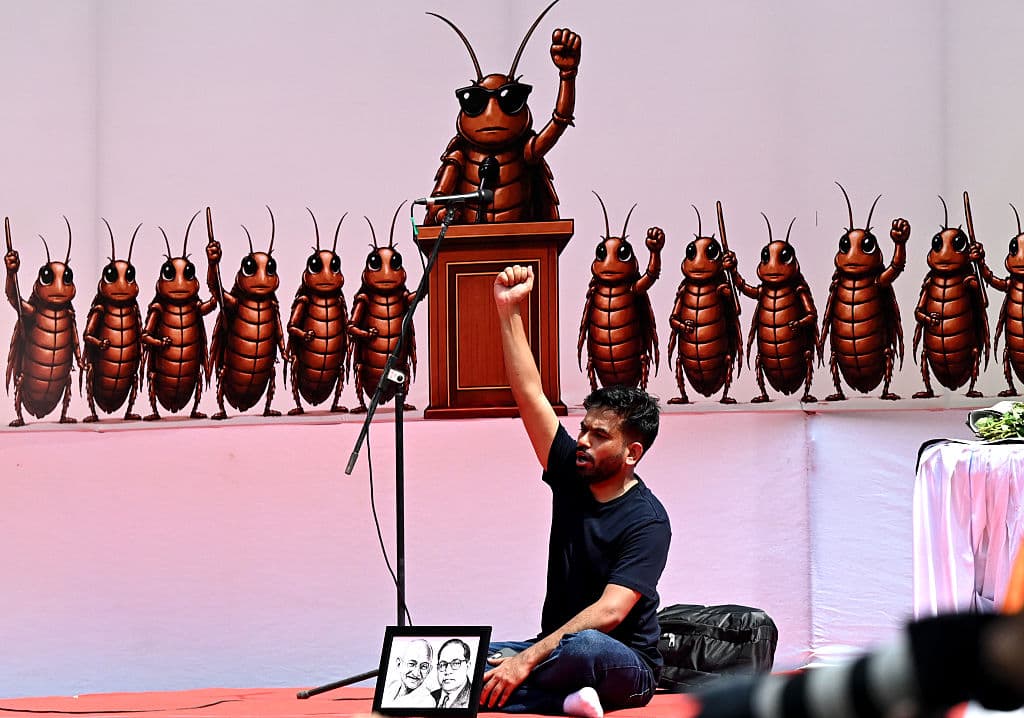
 Protester raises fist beside giant cockroach cutouts mocking the education minister remark.
Youth 'Cockroach' Revolt Forces Modi Minister to Resign
Left says
- •The movement reflects a generational reckoning, with young people rejecting the political loyalty their parents once gave Modi and the BJP.
- •The chief justice's dismissive comparison of unemployed youth to 'cockroaches and parasites' captures a broader contempt from the establishment toward struggling young people, which protesters reclaimed as a badge of pride.
- •The government's violent crackdown, including tear gas and mass detentions during the peaceful 'Chalo Sansad' march, exposes the erosion of democratic space under Modi's rule.
- •This is being described as the most serious democratic challenge to Modi's 12-year hold on power, with anger quickly expanding from the education minister to Modi's broader authoritarian governance style.
Right says
- •The education minister's resignation shows the government listening and responding responsibly to legitimate student grievances over exam integrity rather than digging in.
- •Officials rightly express concern that 'anti-national forces' could exploit youthful frustration for unrelated political agendas, a caution that does not equate to dismissing the students' real pain.
- •The government moved to address concrete demands directly, dropping legal cases against protesters, compensating families of students who died by suicide, and pledging to review exam reforms.
- •Preserving national unity and public order during large, escalating demonstrations is a legitimate governmental responsibility, especially given the size and spread of the protests across more than a dozen cities.
Common Take
High Consensus- The protests began over leaked national entrance exams, particularly the NEET-UG medical exam, which affected millions of students.
- At least 20 student deaths by suicide have been linked to the exam scandal and its fallout.
- Education Minister Dharmendra Pradhan resigned, and the CJP declared victory and ended its five-week protest.
- The government agreed to drop police cases against protesters, compensate affected families, and consider exam reform proposals.
The Arguments
Left argues
The scale and speed of the resignation—after weeks of the government ignoring and vilifying protesters, calling them a 'B team of terrorists'—shows the movement only succeeded once it became an uncontainable political threat, not because the government was listening in good faith.
Right counters
Regardless of the timeline, the outcome is what matters: the minister resigned, cases were dropped, compensation was offered, and reform was promised, which is exactly the responsive governance critics claim doesn't exist under Modi.
Right argues
Warning that 'anti-national forces' could hijack a large, spreading protest movement is a reasonable governance concern given India's history of external actors exploiting domestic unrest, and raising it is not the same as dismissing students' legitimate grievances.
Left counters
This rhetoric follows a well-worn playbook of delegitimizing dissent by insinuating foreign conspiracy, and it was deployed alongside actual tear gas and mass detentions against a movement whose core demands were about exam integrity, not foreign policy.
Left argues
The chief justice's 'cockroaches and parasites' remark, and the government's subsequent crackdown on a peaceful march to parliament, reveal an establishment contempt for struggling young people that the movement's name deliberately weaponized into a badge of pride.
Right counters
A single judicial remark taken out of a specific legal context does not represent the government's overall stance, especially when officials ultimately issued respectful, conciliatory statements praising 'the aspirations, dreams, and expectations of the youth.'
Right argues
Maintaining public order through permits, barricades, and dispersal orders during an escalating, multi-city demonstration is a legitimate exercise of state responsibility, not inherently authoritarian, especially given the risk of unrest spiraling in over a dozen cities.
Left counters
Tear gas, mobile internet shutdowns, and mass detentions against a movement demanding exam accountability go far beyond routine crowd control and reveal how readily the state resorts to repression rather than dialogue.
Left argues
This is a generational rupture—the children of Modi's most devoted supporters are now leading the largest direct challenge to his 12-year rule, suggesting the erosion of his political base runs deeper than one minister's resignation.
Right counters
The protests were explicitly organized around specific, resolvable grievances—exam leaks, compensation, legal cases—and once those concrete demands were met, the movement itself declared victory and stood down, suggesting a targeted policy dispute rather than a referendum on Modi's broader legitimacy.
Challenge Questions
These questions target genuine internal contradictions — meant to provoke honest reflection.
Right asks Left
“If the government's swift concessions—resignation, dropped cases, compensation, promised reforms—are dismissed as merely reactive damage control, what specific government response to mass protest would the left ever recognize as genuine democratic responsiveness rather than authoritarian retreat?”
Left asks Right
“If invoking 'anti-national forces' and warnings about foreign exploitation is a legitimate, good-faith concern rather than a delegitimizing tactic, why was it raised only after weeks of dismissive rhetoric and violent crackdowns failed to quell a movement centered on domestic exam integrity?”
Outlier Report
Left Fringe
Figures like Arundhati Roy who frame this explicitly as an anti-Modi authoritarianism narrative represent maybe 15-20% of the American left commentariat that follows Indian politics closely; most other Americans on the left have only a vague, sympathetic take on 'youth vs. government.'
Right Fringe
Pro-Modi American commentators and Hindu nationalist diaspora voices (e.g., some contributors to outlets like Swarajya or U.S.-based BJP-aligned commentators) who frame protesters as foreign-manipulated agitators represent a small fringe, maybe 10-15% of the American right that pays attention to this story.
Noise Assessment
High noise ratio: most American public opinion on this story is thin and low-salience, meaning the loudest voices (either pro-protest solidarity accounts or pro-Modi diaspora accounts) are disproportionately visible on social media relative to the actual attention paid by average Americans, most of whom are unaware of this story.
Sources (6)
The CJP protest has been the most visible expression of public anger against PM Narendra Modi's government in recent years.
A youth-led protest movement in India is demanding an end to the country’s status quo. Sparked by the leak of national exam questions, tens of thousands of young people have taken to the streets. They are protesting under the banner of the Cockroach Janta (People’s) Party — a new party named to reflect the words of India’s chief justice, who compared unemployed youth to cockroaches and parasites. The movement has only swelled in response to a violent crackdown on protesters. Although the protesters’ initial demands were for the resignation of the country’s education minister, “everything has shifted to directly attacking [Prime Minister Narendra] Modi,” says Indian writer Arundhati Roy, who joins us from New Delhi, the physical center of a movement that first found exponential success online. The erosion of democratic principles under Modi’s right-wing Bharatiya Janata (Indian People’s) Party is being contested on a large scale for the first time, says Roy. “It’s really a generation whose parents and grandparents wore those Modi masks and chanted 'Modi, Modi, Modi,' and got him into power. It is their children now who are saying the emperor has no clothes.”
After weeks of ignored demonstrations, thousands of students, alongside parents, teachers, and supporters from across India marched on Parliament to press their demands. They were met with tear gas, police violence, and detentions.
India’s viral Cockroach Janta Party called off its nationwide protests on Saturday after the country’s education minister resigned and the government agreed to a number of the activist movement’s demands.
Led by Gen-Z youth across India, the movement has become perhaps the biggest challenge to Prime Minister Narendra Modi during his 12 years in office.
What began as outrage over leaked national entrance exams has exploded into one of India's biggest youth-led protest movements in years.