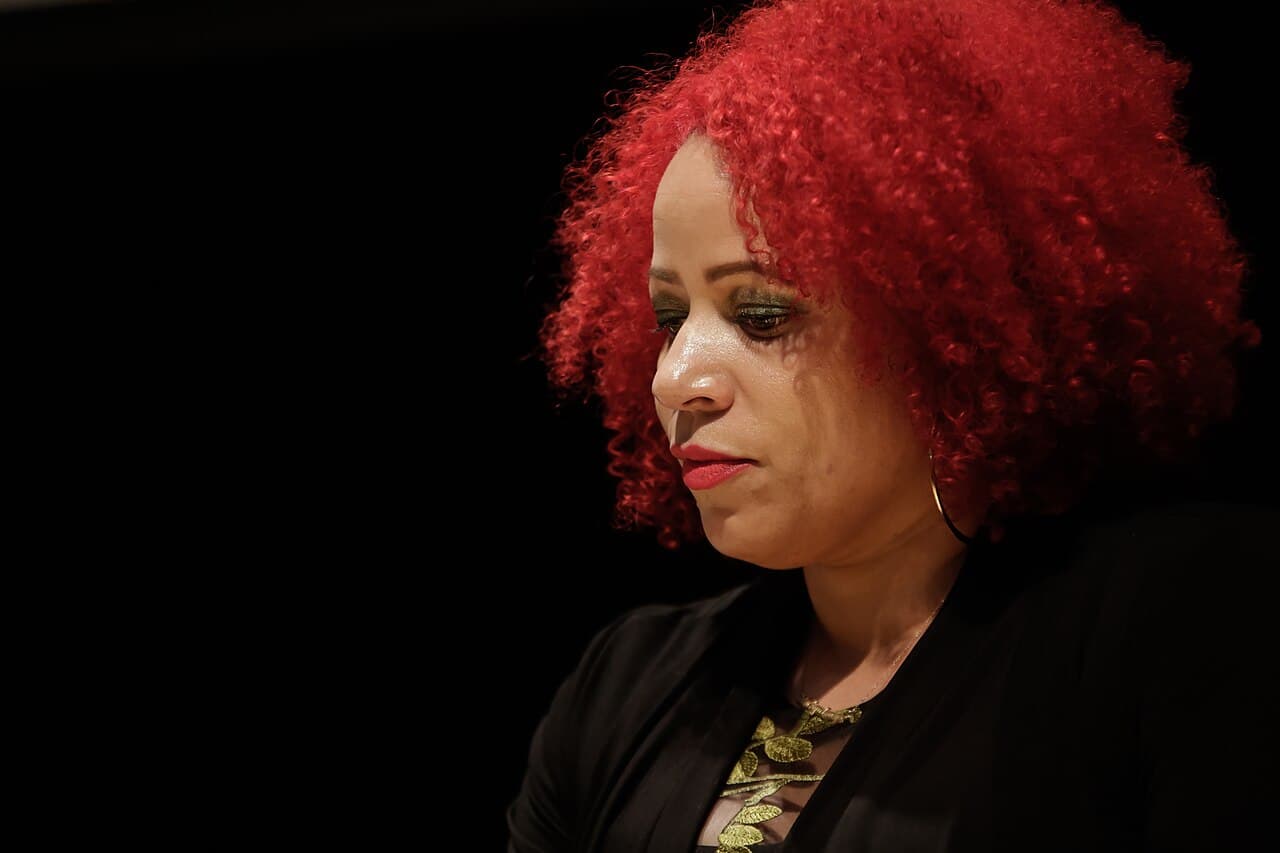
 Nikole Hannah-Jones, creator of the 1619 Project, in a close-up portrait.
1619 Project Creator's School Choice for Her Daughter Sparks Backlash
Left says
- •Nikole Hannah-Jones publicly reflecting on a painful family decision shows vulnerability rather than weakness, and her willingness to write candidly about her daughter's struggles deserves recognition rather than mockery.
- •Her choice to enroll her daughter in a majority-Black neighborhood school reflected a genuine belief in systemic equity and a refusal to abandon public schools serving low-income Black children, a value many families share but rarely have scrutinized so publicly.
- •The real story is one of systemic neglect: chaotic, unsupervised classrooms, teachers failing to correct student work, and no homework point to chronic underinvestment in schools serving Black and low-income students, not to any personal failing of one parent.
- •Turning a mother's personal essay about her child's education into a vehicle for broad political attacks on her ideology or character sidesteps the harder conversation about why so many public schools remain under-resourced and unequal.
Right says
- •Hannah-Jones' own account shows that ideology, not evidence, drove her decision to place her daughter in a demonstrably failing school, and the predictable academic harm that followed validates long-standing conservative critiques of that mindset.
- •The essay is being read as an implicit admission that school quality, discipline, and instruction matter more than the racial composition of a school, an argument charter-school and school-choice advocates have made for years.
- •Critics argue that even after describing violent, chaotic classrooms and teachers who failed to teach basic skills, Hannah-Jones stops short of reconsidering her broader ideological commitments or crediting alternatives like charter or choice-based schools.
- •Some point out that the school itself used curriculum tied to the 1619 Project, arguing this reflects a deeper concern that ideological curricula can come at the expense of foundational academic instruction.
Common Take
High Consensus- Both sides agree that Nikole Hannah-Jones' daughter experienced serious academic setbacks, including gaps in basic math skills identified only after she transferred schools.
- Both acknowledge that the school environment described included unsupervised, sometimes violent classrooms and inconsistent instruction.
- Both recognize that Hannah-Jones made her schooling decision deliberately and based on strongly held personal values about educational equity.
- Both sides agree the essay has sparked wider public debate about the state of public education in schools serving predominantly Black and low-income communities.
The Arguments
Left argues
Hannah-Jones' willingness to publicly document her daughter's struggles, including uncomfortable details about failed instruction, represents genuine vulnerability that should be respected rather than weaponized against her.
Right counters
Vulnerability doesn't immunize someone from accountability for the real-world consequences of ideologically-driven decisions, especially when that person has built a public career prescribing similar choices to others.
Right argues
Hannah-Jones' own narrative shows that she chose a school based on its racial composition and symbolic value rather than its academic quality, and the predictable harm to her daughter's math and writing skills validates concerns that ideology overrode evidence.
Left counters
The failure belongs to a chronically underfunded school system that let violence go unchecked and teachers skip basic instruction, not to a parent's values-driven choice to support public education serving Black children.
Left argues
The real scandal is systemic: unsupervised chaotic classrooms, teachers not correcting work, and no homework reflect decades of underinvestment in schools serving low-income Black students, a structural problem no single family's choice created or could fix.
Right counters
Acknowledging systemic neglect doesn't explain why Hannah-Jones, who had the resources and information to choose a better school, still chose to send her own child into that neglect as a matter of principle rather than protecting her from it.
Right argues
Critics note that even after describing years of documented harm, Hannah-Jones never revisits her broader ideological opposition to school choice or charters, suggesting a refusal to let personal experience update her public politics.
Left counters
Not every personal essay needs to conclude with a policy pivot; expecting a mother's reflection on her family's pain to double as a political concession is an unfair burden not placed on other writers exploring hard personal choices.
Right argues
The revelation that the school used 1619 Project curriculum while failing to teach basic math and grammar suggests that ideological content was prioritized over foundational academic skills, reinforcing concerns about curricula driven more by narrative than rigor.
Left counters
Conflating a school's failure to teach math with its unrelated use of a historical curriculum implies causation without evidence, when understaffing, poor oversight, and lack of resources are the more direct explanations for academic failure.
Challenge Questions
These questions target genuine internal contradictions — meant to provoke honest reflection.
Right asks Left
“If systemic neglect alone explains the school's failures, why does the left's synopsis treat scrutiny of the specific parental decision to enroll a child there as illegitimate, rather than as one legitimate factor among several worth examining?”
Left asks Right
“If the core lesson is that school quality and discipline matter more than racial composition, why do critics focus so heavily on Hannah-Jones' ideology and so little on whether charter or choice-based schools in similar under-resourced neighborhoods reliably produce better outcomes?”
Outlier Report
Left Fringe
Writers at outlets like The Nation or Jacobin who might argue Hannah-Jones didn't go far enough and that even she remains too accommodating of school choice/testing culture represent a small sliver (~10%) of the left willing to critique her from a more radical anti-meritocracy angle.
Right Fringe
Commentators like those at The Federalist (e.g., pieces calling her a 'race-grifter') represent a more inflammatory fringe (~20-25% of the right) that frames this as personal moral failure and racial grievance-mongering rather than engaging with systemic school funding issues.
Noise Assessment
High - much of the loudest reaction (National Review, The Federalist) is opinion commentary designed to score ideological points against a prominent, controversial figure, rather than reflecting broad public sentiment; average parents' views on school choice are more pragmatic and less inflammatory than the discourse suggests.
Sources (13)
Her mea culpa about her daughter’s schooling is neither brave nor admirable. <img src="https://i0.wp.com/www.nationalreview.com/wp-content/uploads/2026/09/nikole-hannah-jones-essence.jpg?fit=617%2C360&ssl=1" />
The New York City public schools mugged her, and yet she still doesn’t want to press charges. <img src="https://i0.wp.com/www.nationalreview.com/wp-content/uploads/2026/09/nikole-hannah-jones.jpg?fit=617%2C360&ssl=1" />
All she wanted to do was blame America harder. Instead, she may be opening the gates to charter schools and ending the madness seen in New York City's public schools.
Nikole Hannah-Jones Admits Defeat
<img alt="Nikole Hannah-Jones" class="webfeedsFeaturedVisual wp-post-image" src="https://thefederalist.com/wp-content/uploads/2021/12/Nikole-Hannah-Jones-e1640658725782-1200x675.png" style="display: block; margin: auto; margin-bottom: 5px;" />In classical terms, the purpose of education is to impart not just knowledge but also virtue. For NHJ, it's just a credentialing mechanism.
<img alt="Nikole Hannah-Jones" class="webfeedsFeaturedVisual wp-post-image" src="https://thefederalist.com/wp-content/uploads/2026/09/NHJ-1200x675.jpg" style="display: block; margin: auto; margin-bottom: 5px;" />Public schools are terrible because DEI absolves families of responsibility for their choices.
<img alt="Nikole Hannah-Jones" class="webfeedsFeaturedVisual wp-post-image" src="https://thefederalist.com/wp-content/uploads/2026/09/Nikole_Hannah-Jones_42609596254-1200x675.jpg" style="display: block; margin: auto; margin-bottom: 5px;" />Hannah-Jones' ideology did not just ruin her own daughter's academic potential by choice; it also poisons by force the educations of countless other students who attend the schools where the ideology has free rein.
The New York Times writer credits her own adult success with attending wealthier schools outside her neighborhood. So why does she blame New York City's education problems on choice?
Nikole Hannah-Jones' controversial essay asks if you can fight for a better world while accepting the one you have
Superstar New York Times reporter Nikole Hannah-Jones confessed to the world this week how she sacrificed her daughter Najya to her own political project.
School choice is necessary for all children to reach their full potential. But it isn't sufficient.
In classical terms, the purpose of education is to impart not just knowledge but also virtue. For NHJ, it's just a credentialing mechanism.
Nikole Hannah-Jones' controversial essay asks if you can fight for a better world while accepting the one you have