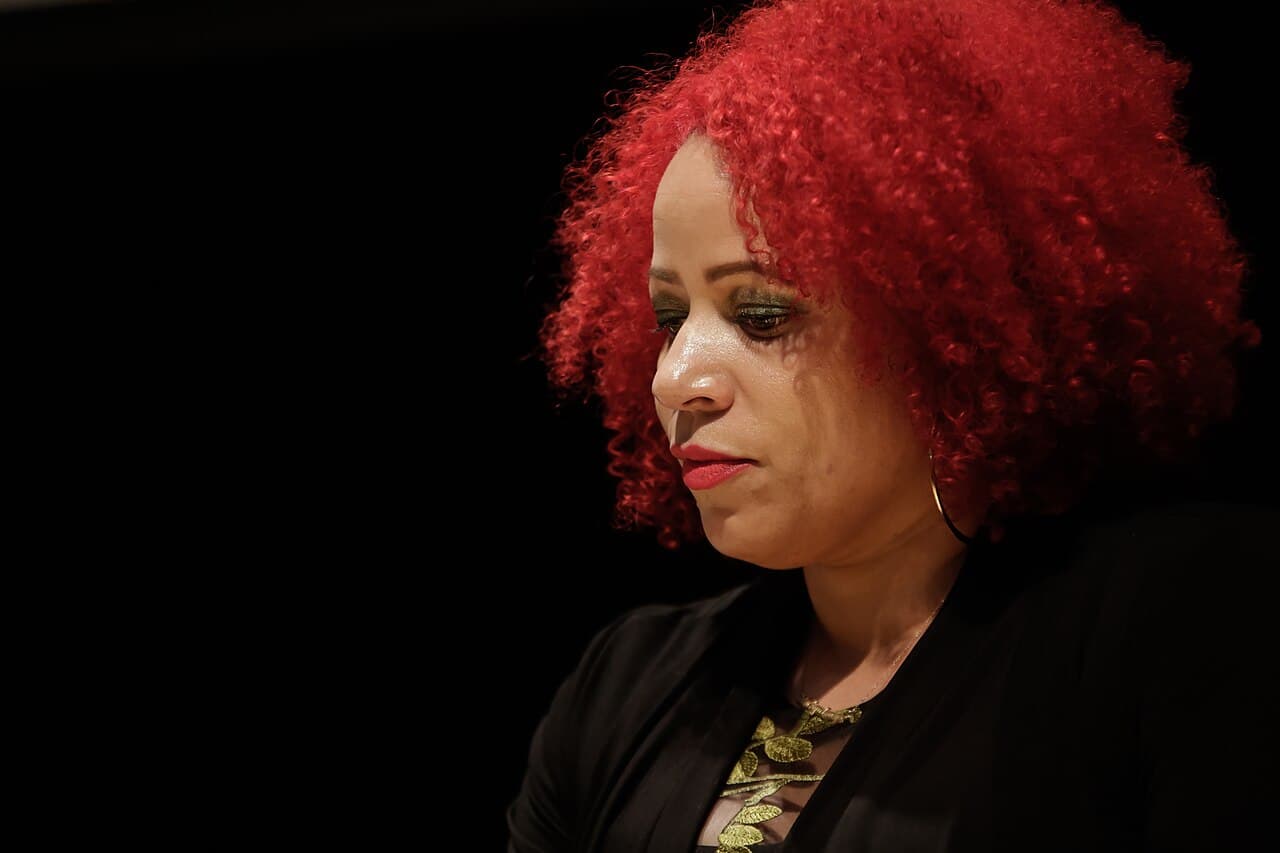
 Nikole Hannah-Jones, the journalist at the center of the schooling controversy.
Hannah-Jones Sent Her Daughter to Segregated Schools to Prove a Point
Intra-Party Split Detected
Most left-leaning commentary defends Hannah-Jones's essay as an honest grappling with the tension between idealism and parenting, but some on the left (e.g. The Atlantic) emphasize systemic failure over her individual choice, while others voice quieter discomfort with prioritizing ideology over a child's education, showing subtle divergence in framing and sympathy.
Left says
- •Hannah-Jones made a deliberate, well-researched choice to invest in a struggling public school as an act of solidarity, believing that systemic change requires families with resources to stay and fight rather than opt out.
- •The essay is a rare act of public self-reflection about the painful tension between idealism and parental duty, not a simple confession of wrongdoing.
- •Blaming her individually deflects from the real culprit: decades of underfunding, segregation, and disinvestment in schools serving Black and low-income students.
- •Her daughter's struggles illustrate a systemic failure that affects thousands of children whose parents cannot write op-eds about it, making the story bigger than one family's choice.
Right says
- •A parent's first obligation is to their own child's education and future, not to a political or ideological experiment, however well-intentioned.
- •The essay reveals that the school Hannah-Jones chose left her daughter with real academic gaps, particularly in math, undercutting claims that ideology alone can overcome poor school quality.
- •The same school used Hannah-Jones's own 1619 Project curriculum, raising questions about whether ideological priorities crowded out foundational academics.
- •Families who choose selective, higher-performing, or private schools for their children are exercising reasonable judgment, not perpetuating injustice, and shouldn't be shamed for seeking excellence.
Common Take
High Consensus- Hannah-Jones's daughter attended a predominantly Black, high-poverty public school in Brooklyn before later transferring to a selective specialized high school.
- The essay, published in The New York Times Magazine, describes real academic struggles the daughter faced, including gaps in math preparedness compared to peers.
- Both sides agree that underfunded, underperforming schools remain a serious problem affecting many children's educational outcomes.
- Parents across the political spectrum want their children to receive a strong education and grapple with hard tradeoffs in choosing schools.
The Arguments
Left argues
Hannah-Jones made a deliberate, informed choice to invest in a struggling public school as an act of solidarity, believing systemic change requires families with resources and options to stay and fight rather than exit the system entirely.
Right counters
A parent's primary obligation is to their own child's concrete educational needs, not to a political experiment; treating a child's schooling as a means to a systemic end risks sacrificing her real interests for an abstract cause.
Right argues
The essay itself shows the school left Hannah-Jones's daughter with significant academic gaps, especially in math, which undercuts the notion that ideological commitment or parental investment can compensate for a genuinely underperforming school.
Left counters
One family's outcome doesn't disprove the systemic argument; the gaps reveal exactly the kind of resource and instructional deficits that decades of underfunding and segregation produce, which is the whole point Hannah-Jones is making.
Left argues
Focusing blame on Hannah-Jones as an individual mother deflects from the real story: thousands of children face the same underfunded, unequal schools every day, but only her family's story gets national attention because she can write about it.
Right counters
Individual accountability and systemic critique aren't mutually exclusive, but Hannah-Jones specifically chose to make her own daughter a test case for her ideology, which invites scrutiny of that specific parenting decision rather than only the system.
Right argues
The revelation that the same school used the 1619 Project curriculum raises a legitimate question about whether ideological priorities in the classroom crowded out foundational instruction in math and reading.
Left counters
There's no evidence presented that curriculum choices about history education caused math deficiencies; conflating the two implies causation from mere proximity and ignores well-documented funding and staffing disparities as the more direct cause.
Right argues
Parents who choose selective, private, or high-performing schools for their children, including Black families like the Daily Wire author's, are exercising reasonable judgment in pursuit of excellence and shouldn't be shamed as complicit in segregation.
Left counters
Individual opt-outs, however reasonable for each family, collectively drain resources, engagement, and advocacy from public schools, perpetuating the very inequality that makes those schools worth escaping in the first place.
Challenge Questions
These questions target genuine internal contradictions — meant to provoke honest reflection.
Right asks Left
“If systemic change requires resourced families to stay and fight rather than opt out, what threshold of harm to one's own child would justify leaving, and how is that threshold different from the standard other parents already use when they choose better schools?”
Left asks Right
“If the solution to failing schools is simply to let individual families choose better options for their own children, what happens to the children left behind whose families lack the resources, knowledge, or opportunity to do the same?”
Outlier Report
Left Fringe
Writers and activists like those at Salon and some progressive education-equity advocates who frame any personal criticism of Hannah-Jones as an attack on anti-racist education itself; roughly 15-20% of the left holds this uncompromising defense.
Right Fringe
Commentators like those at The Federalist who frame Hannah-Jones as a 'race-grifter' deliberately sabotaging her own child, an extreme personalization that goes beyond mainstream conservative school-choice arguments; likely 15-20% of the right.
Noise Assessment
Significant amplification from media figures and Twitter/X debates far exceeds how much ordinary parents are actually engaging with or forming strong opinions on this specific essay.
Sources (9)
My parents chose the best for me. They chose to send me, a black boy, to a competitive, majority-white and Asian private school. I was challenged with rigorous homework, test routines, and expansive extracurriculars in athletics and the arts. Through my parents’ striving, I got the chance to learn, grow, and succeed – it’s unfathomable ...
Nikole Hannah-Jones' controversial essay asks if you can fight for a better world while accepting the one you have
Superstar New York Times reporter Nikole Hannah-Jones confessed to the world this week how she sacrificed her daughter Najya to her own political project.
Progressives have long subordinated individual students to the cause of racial justice. <img src="https://i0.wp.com/www.nationalreview.com/wp-content/uploads/2026/09/nhj1.jpg?fit=617%2C360&ssl=1" />
Nikole Hannah-Jones' controversial essay asks if you can fight for a better world while accepting the one you have
Low-income Black urban schools don't need more educated parents. They need discipline, accountable teachers and an end to ideology that excuses chaos.
Fixing troubled schools requires collective action, and no one should underestimate the difficulty.
<img alt="Nikole Hannah-Jones" class="webfeedsFeaturedVisual wp-post-image" src="https://thefederalist.com/wp-content/uploads/2026/09/Nikole_Hannah-Jones_42609596254-1200x675.jpg" style="display: block; margin: auto; margin-bottom: 5px;" />Hannah-Jones' ideology did not just ruin her own daughter's academic potential by choice; it also poisons by force the educations of countless other students who attend the schools where the ideology has free rein.
The New York Times writer credits her own adult success with attending wealthier schools outside her neighborhood. So why does she blame New York City's education problems on choice?