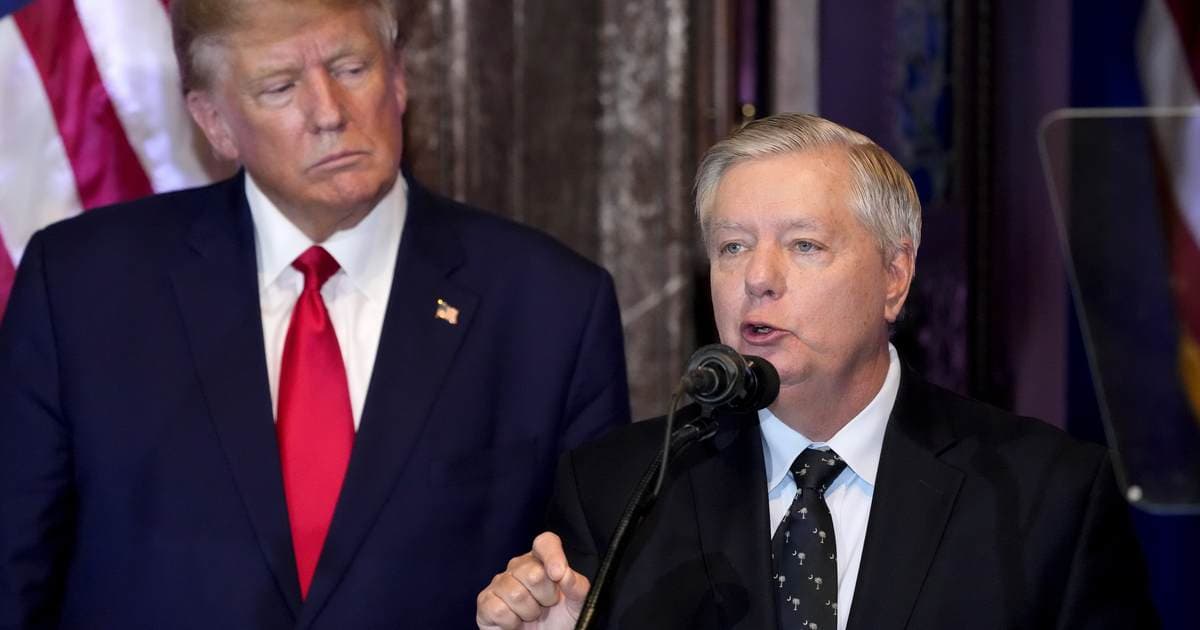
 President Trump and Sen. Lindsey Graham, key sponsor of Russia sanctions bill, together.
Russia Sanctions Bill Splits Both Parties on Trump's Tariff Power
Intra-Party Split Detected
House Democratic leaders including Hakeem Jeffries opposed the bill over concerns about expanded tariff authority for Trump, while 58 rank-and-file Democrats broke ranks to support it. On the Republican side, seven GOP members from the isolationist wing (Massie, Harris, Norman, Self, McClintock, Roy, Davidson) voted against the bill despite party leadership backing.
Left says
- •Democratic leaders, including Hakeem Jeffries, opposed the bill primarily because it grants Trump sweeping new tariff authority that lacks oversight or a clear expiration, fearing he could wield it against nations of his choosing under vague pretexts.
- •Rep. Don Beyer warned the legislation contains a loophole broad enough to let the president label virtually any country a Russia-sanctions evader and hit it with tariffs up to 100% without guardrails.
- •Despite leadership's objections, 58 rank-and-file Democrats crossed over to support the bill, reflecting a genuine desire to punish Russia's war machine and stand with Ukraine even while distrusting how Trump might use the new powers.
- •The bill's supporters frame it as essential to cutting off the revenue, particularly from oil and gas sales to China and India, that funds Russia's continued assault on Ukrainian civilians.
Right says
- •Isolationist-leaning Republicans, including Reps. Massie, Roy, Davidson and Norman, opposed the bill out of broader resistance to deeper U.S. entanglement in the Russia-Ukraine conflict, arguing against expansive foreign sanctions regimes generally.
- •Mainstream Republicans, led by Speaker Mike Johnson and Majority Leader Steve Scalise, pushed hard for bipartisan buy-in and only advanced the bill once the White House signaled support, seeing it as a tool to pressure Putin toward peace.
- •Supporters like Rep. Michael McCaul frame the bill as a moral necessity, arguing America must use every available tool to cripple Russia's war machine and pursue a just end to the war.
- •Some on the right label the bill a 'neocon' priority, expressing skepticism toward the broader foreign policy establishment's push for continued sanctions and involvement despite the measure's Republican-led origins.
Common Take
High Consensus- The bill passed the House 262-159 and now heads to Trump's desk for signature.
- The legislation is named the Lindsey O. Graham Sanctioning Russia and Iran Act of 2026, honoring the late senator who spent over a year negotiating it.
- It authorizes tariffs of up to 100% on the top five importers of Russian oil and gas, potentially including China and India, along with sanctions on Russian officials, banks, and the shadow fleet of tankers.
- The vote crossed party lines in both directions, with 58 Democrats voting yes and seven Republicans voting no, reflecting genuine internal divisions rather than a clean partisan split.
The Arguments
Left argues
Democratic leaders argue the bill's tariff provision is written so broadly that Trump could label virtually any country a sanctions-evader and impose tariffs up to 100% with no expiration or congressional oversight, effectively handing him a blank check for economic warfare disguised as Russia policy.
Right counters
Supporters note the final bill actually narrowed the tariff authority from an earlier 500% blanket rate to a targeted 100% tariff limited to the top five importers of Russian oil and gas, with a specific carve-out for countries reducing their dependence, making it a more constrained tool than critics suggest.
Right argues
Mainstream Republicans led by Speaker Johnson and Majority Leader Scalise argue the bill gives Trump 'every tool in the toolbox' to cut off the oil revenue funding Russia's war and pressure Putin toward a just peace, framing it as a moral necessity after years of civilian deaths in Ukraine.
Left counters
Rank-and-file Democratic skeptics counter that morality and mechanism are separate questions — even lawmakers sympathetic to punishing Russia worry that granting a president unchecked tariff power in the name of Ukraine sets a precedent that could be exploited far beyond this conflict.
Right argues
Isolationist Republicans like Massie, Roy, Davidson and Norman argue the bill represents deeper U.S. entanglement in a foreign war and expands sanctions regimes that rarely achieve their stated goals, reflecting a broader philosophical resistance to interventionist foreign policy regardless of the target.
Right counters
Bill supporters like Rep. McCaul respond that sanctions and tariffs are precisely the non-military tools that allow the U.S. to pressure Russia without troops or direct conflict, making this the responsible alternative to isolationism rather than an escalation toward war.
Left argues
Despite leadership's objections, 58 Democrats crossed over to support the bill, showing genuine bipartisan appetite to punish Russia's war machine and stand with Ukraine even among those who distrust Trump — suggesting the substance of countering Russia outweighed process concerns for many.
Left counters
Leadership and holdouts like Beyer argue that supporting Ukraine and opposing unchecked executive tariff power are not mutually exclusive, and that Democrats should have insisted on stripping the loophole in the Rules Committee rather than accepting a flawed structural precedent for a good cause.
Right argues
Some conservatives label the bill a 'neocon' priority, arguing it reflects the foreign policy establishment's reflexive push for sanctions and continued involvement in conflicts that don't directly threaten U.S. interests, regardless of which party controls the White House.
Right counters
Establishment Republicans note the bill only advanced after explicit White House support and was negotiated directly with Trump's team, undercutting the claim that it represents establishment overreach rather than a deal Trump himself endorsed as serving his own foreign policy goals.
Challenge Questions
These questions target genuine internal contradictions — meant to provoke honest reflection.
Right asks Left
“If 58 of your own rank-and-file members judged that punishing Russia's war machine was worth granting this tariff authority, on what basis should party leadership's institutional distrust of Trump override that judgment as the party's official position?”
Left asks Right
“If the isolationist wing of your party is right that expansive sanctions and tariff authority represent dangerous foreign entanglement, how do you justify handing that same expansive tariff power to a president your own leadership insisted must have it to fight this war?”
Outlier Report
Left Fringe
Progressive isolationist-adjacent voices and some in the 'restrainer' foreign policy camp (though rare on the left) who oppose expanding presidential tariff power on principle even for sanctions purposes represent maybe 10-15% of the left; most Democratic opposition is pragmatic/institutional (Jeffries, Beyer) rather than fringe.
Right Fringe
Reps. Thomas Massie, Chip Roy, Warren Davidson, and Ralph Norman represent a small isolationist/America First faction, roughly 10-15% of the House GOP conference, who oppose broader U.S. entanglement in the Russia-Ukraine conflict and label the bill a 'neocon' priority, as reflected in Daily Caller's framing.
Noise Assessment
Moderate noise: the bipartisan 262-159 vote and near-unanimous 86-11 Senate passage suggest genuine broad consensus, while the loudest media narratives (Democratic leadership objections, GOP isolationist dissent) amplify intra-party friction beyond what actual public opinion polling would likely show, since most voters are not tracking granular tariff-authority mechanics.
Sources (11)
The House passed a Russia and Iran sanctions bill championed by late Sen. Lindsey Graham Wednesday night.
<p>The House passed a sweeping <a href="https://www.axios.com/2026/07/29/senate-russia-sanctions-lindsey-graham" target="_blank">Russia sanctions</a> bill Thursday, sending the long-awaited legislation to President Trump's desk. </p><p><strong>Why it matters:</strong> The measure would significantly expand economic pressure on Russia while handing Trump fresh authority to impose secondary tariffs of up to 100% on buyers of Russian oil and gas.</p><hr /><ul><li>It would also target Russia's "shadow fleet," the network of aging tankers used to evade Western sanctions while exporting Russian oil.</li><li>The vote was 262-159.</li><li>The bill was renamed in honor of its lead sponsor, the late Sen. <a href="https://www.axios.com/2026/07/12/lindsey-graham-dies-john-mccain-trump" target="_blank">Lindsey Graham</a> (R-S.C.), who died suddenly in July.</li></ul><p><strong>Driving the news:</strong> The bill scrambled the usual partisan lines on Russia and Ukraine, with <a href="https://www.axios.com/2026/09/15/russia-sanctions-trump-tariffs-house-democrats" target="_blank">House Democratic leaders opposing it</a> while some rank-and-file Democrats backed the measure.</p><ul><li>Democratic leaders objected primarily over provisions handing Trump more tariff authority.</li><li>Republicans rejected Democratic efforts in the Rules Committee earlier this week to strip the tariff authority or narrow how it could be used.</li><li>Republicans in the isolationist wing of the party opposed the legislation amid broader resistance to further U.S. involvement in the Russia-Ukraine war. </li></ul><p><strong>Catch up quick:</strong> The legislation has been more than a year in the making, dating back to a sanctions push Graham and dozens of senators launched in April 2025.</p><ul><li>The sanctions package has long had wide bipartisan support, but concerns from the White House held it up for months. Graham had been the key negotiator with the White House. </li><li>The Senate <a href="https://www.axios.com/2026/08/07/senate-republicans-democrats-russia-sanctions" target="_blank">passed the measure</a> last month with broad bipartisan support after Trump officially backed the legislation.</li></ul>
The bill was championed by GOP Sen. Lindsey Graham, who died suddenly just one day after announcing a deal had been reached with the White House to move forward.
The House on Wednesday evening passed a Russia sanctions bill championed by the late Sen. Lindsey Graham. CBS News congressional reporter Taurean Small has the latest.
‘should be bipartisan consensus’
The legislation, which passed the Senate last month, would target Russia’s energy sector by punishing the largest buyers of its oil and gas to slash revenues Russia uses to attack Ukraine.
The legislation was named for the late South Carolina Republican. It gives the president authority to impose tariffs on top importers of oil and natural gas from Russia, such as China and India.
The House on Wednesday passed a broad package of sanctions targeting Russian officials and key pillars of its economy as lawmakers look to deprive President Vladimir Putin of the financial resources needed to wage the war against Ukraine.
The House on Wednesday passed legislation granting President Trump tariff authorities to sanction countries purchasing Russian energy and impose tougher sanctions against the Kremlin over its war in Ukraine. The bill will now be sent to Trump’s desk for his signature, marking the end of a more than year and a half journey for legislation…