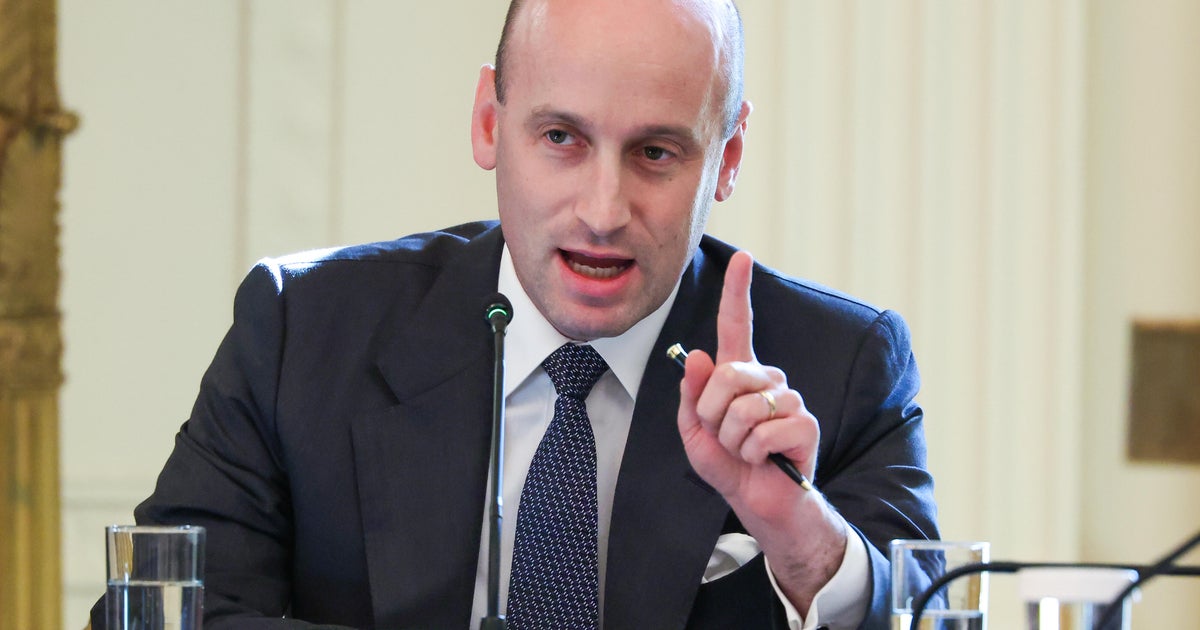
Trump Names Immigration Hardliner Stephen Miller as Chief of Staff
Intra-Party Split Detected
Some Republicans and Trump advisers worry that elevating Miller and doubling down on hard-line immigration enforcement could further alienate independent and moderate voters after midterm losses, while others see him as key to reenergizing the MAGA base.
Left says
- •Miller believes presidential power is nearly limitless and has dismissed court rulings against Trump policies as the work of 'radical rogue judges,' raising concerns about checks on executive authority.
- •He has called the Democratic Party a 'domestic extremist organization,' signaling an intent to treat the opposition as an enemy rather than a governing partner during a time Democrats control Congress.
- •His record includes architecting family separations, the Muslim travel ban, and historic cuts to refugee admissions, policies that drew widespread legal challenges and humanitarian criticism.
- •His elevation suggests Trump plans to double down on hard-line immigration enforcement and executive-order governance rather than moderate course after the midterm losses, risking further alienation of independent voters.
Right says
- •Trump describes Miller as one of his most trusted advisers, rewarding a loyal aide with deep experience in policy execution and crisis management.
- •Miller's allies point to his oversight of the Department of Homeland Security and leadership of a large White House policy team as evidence he's prepared for the chief of staff role.
- •With legislative action stalled, Miller's expertise in executive orders and legal strategy positions him well to keep advancing Trump's agenda through the courts and agencies.
- •Supporters see Miller as the person who can reenergize the MAGA base ahead of 2028, especially after turnout dipped among populist voters in the midterms.
Common Take
High Consensus- Stephen Miller has served as deputy chief of staff for policy since January 2025 and is replacing Susie Wiles.
- Miller has been a central architect of Trump's immigration policies across both administrations, including the travel ban and enforcement expansion.
- The announcement comes just after Republicans suffered significant losses in the midterm elections.
- Democrats are expected to launch investigations into the administration, and Miller's appointment is widely seen as preparation for heightened political conflict.
The Arguments
Left argues
Miller's view that presidential power 'will not be questioned' and his dismissal of adverse court rulings as the work of 'radical rogue judges' signals a governing philosophy hostile to judicial checks on executive authority.
Right counters
Miller is articulating frustration with specific rulings he views as judicial overreach into core executive functions like immigration enforcement, not rejecting judicial review as an institution; past bans and policies still went through the courts, including the Supreme Court.
Right argues
Trump is elevating a trusted, deeply experienced aide who has run DHS policy coordination and one of the White House's largest policy teams, making him well-prepared to manage the operational and legal complexity of the chief of staff role.
Left counters
Policy expertise in one area, especially an ideologically narrow and controversial one like hardline immigration enforcement, is not the same as the broad managerial and coalition-building skill the chief of staff role has traditionally required.
Left argues
Calling the Democratic Party a 'domestic extremist organization' while Democrats now control both houses of Congress suggests Miller intends to govern through confrontation rather than negotiation, deepening dysfunction at a moment that demands cooperation.
Right counters
Sharp rhetoric about political opponents is common across the spectrum and doesn't necessarily preclude practical dealmaking; Miller's defenders argue his bluntness is tactical messaging aimed at the base, not a literal blueprint for refusing to work with Congress.
Right argues
With legislative action stalled after the midterms, Miller's specific expertise in executive orders and litigation strategy makes him the right tool for a White House that must now govern primarily through agencies and the courts.
Left counters
Leaning harder into unilateral executive action and legal brinkmanship is precisely the approach that triggered the legal battles and public backlash that contributed to the midterm losses in the first place.
Left argues
Miller's record of family separations, the Muslim travel ban, and record-low refugee admissions reflects an approach that drew sustained humanitarian criticism and legal challenges, and elevating him signals no course correction despite voter backlash.
Right counters
Those same policies were ultimately implemented and, in the travel ban's case, upheld by the Supreme Court, showing Miller operates within legal bounds even when his methods are controversial; supporters argue his hardline record is precisely why the base wants him back in a position of power.
Challenge Questions
These questions target genuine internal contradictions — meant to provoke honest reflection.
Right asks Left
“If courts and legal processes ultimately upheld key Miller-crafted policies like the travel ban, does labeling his approach a threat to judicial checks overstate the case, given that the system of review still functioned?”
Left asks Right
“If Miller's chief qualification is deep expertise in one contentious policy area and sharp partisan rhetoric, how does that square with claims he's prepared for the broad, cross-cutting managerial and political role the chief of staff position has historically demanded?”
Outlier Report
Left Fringe
Figures like Rep. Alexandria Ocasio-Cortez and immigration advocacy groups (e.g., RAICES, ACLU) frame Miller's appointment as authoritarian and racist, representing roughly 25-30% of the left that uses the most alarmist 'threat to democracy' framing versus more measured Democratic criticism.
Right Fringe
Commentators like Roger Stone and some America First media figures (e.g., Steve Bannon's War Room) celebrate Miller as a 'wartime consigliere' pushing for maximal executive power and confrontation with courts, representing perhaps 20% of the right that explicitly endorses testing constitutional limits rather than just supporting strict immigration policy.
Noise Assessment
High noise ratio—cable news and social media amplify Miller as either savior or villain, while most Americans' actual views are more nuanced, focused on economic concerns post-midterms rather than deep engagement with chief-of-staff personnel dynamics.
Sources (5)
Stephen Miller, appointed by President Donald Trump to replace White House Chief of Staff Susie Wiles just days after Republicans suffered a blowout in the midterms, is expected to continue his hard-line approach on immigration and national security—and was also told by a top Democrat to "lawyer up." Trump announced Miller, who has served as deputy chief of staff for policy since January 2025, as his new chief of staff in a Truth Social post on Friday, describing him as "one of my most trusted advisors."...
<p><a href="https://www.axios.com/2026/11/06/susie-wiles-trump-stephen-miller-chief-of-staff" target="_blank">Stephen Miller</a> is no Susie Wiles: He believes in almost limitless presidential power, considers the Democratic Party an extremist organization, and dreams of ruthless crackdowns on immigration and foreign adversaries.</p><p><strong>Why it matters: </strong>Miller, the new White House chief of staff, isn't just unlike anyone who's had the job under Trump — he's unlike any to occupy the powerful position in the modern era. He puts the<em> hard</em> in hard-liner and understands how to pull the levers of power to get his way and make the U.S. government a MAGA machine.</p><hr /><p><strong>Miller's appointment sets the stage</strong> for two years of partisan warfare with the new Democratic-led Congress, which is likely to launch investigations of Trump's administration, political committees and allies.</p><ul><li>"Stephen is Trump's wartime consigliere," Roger Stone, one of the president's oldest friends and advisers, told Axios.</li></ul><p><strong>The big picture:</strong> Despite his post-midterm comments about finding ways to work with Democrats, Trump's choice of Miller signals that he's not looking for truces. He's prepping for war, and sees Miller as a brass-knuckle general and tactical expert impervious to criticism or traditional restraints.</p><p><strong>Trump's MAGA brain</strong> for a decade, the 41-year-old has detailed his Miller Doctrine in speeches, policies and press conferences:</p><ol><li><strong>Presidential power is "very substantial</strong> <strong>and will not be questioned." </strong>Miller said those words about Trump's Muslim travel ban in 2017 on CBS's <a href="https://www.cbsnews.com/news/face-the-nation-transcript-february-12-2017-schumer-flake-miller/" target="_blank">"Face the Nation,"</a> but to him they broadly apply to other areas of the executive's authority.</li><li><strong>Court authority is limited.</strong> In May 2025, when courts blocked aspects of Trump's deportation policies, Miller <a href="https://www.pbs.org/newshour/show/top-trump-adviser-suggests-white-house-could-suspend-habeas-corpus-to-deport-migrants" target="_blank">said</a> the rulings were the work of "radical rogue judges" who were "at war" with the executive and legislative branches.</li><li><strong>The political opposition is a threat to America.</strong> "The Democrat Party is not a political party. It is a domestic extremist organization," Miller <a href="https://www.facebook.com/reel/803495362339152" target="_blank">told</a> Sean Hannity in August 2025. He also warned that if Democrats won Congress, "it's game over." They just won it.</li><li><strong>Homeland security is the nation's spine.</strong> A key architect of the administration's hard-line immigration policies, Miller said in a March speech: "Our national security, our homeland security, the safety and well-being of our people begins at home, begins in our neighborhood, begins in our home region."</li><li><strong>America should use "hard power" in the Western Hemisphere.</strong> "The cartels that operate in this hemisphere are the ISIS and the al-Qaeda of the Western Hemisphere, and should be treated just as brutally and just as ruthlessly as we treat those organizations," Miller said in the same speech, to foreign leaders at the Shield of the Americas conference.</li></ol><p><strong>Behind the scenes:</strong> Miller's Shield of the Americas speech indicated the depth of his involvement in Trump's Latin America policy. He has a keen interest in Mexico and was a driving force in the military action leading up to and including the deposing of Venezuela's Nicolás Maduro. </p><ul><li>Miller has a close working relationship with Secretary of State and National Security Adviser Marco Rubio, and he has friendly relations with El Salvador leader Nayib Bukele, a crucial Trump ally in extending U.S. power.</li><li>"Stephen makes Marco more aggressive on policy, in a good way. When Stephen isn't around, Marco defaults back to being more of the politician," said one White House official who worked with the two.</li><li>"If people thought regime change in Cuba was going to fall by the wayside, Stephen Miller should make them think twice," the source said. "Today is a bad day for the Cuban regime."</li></ul><p><strong>Go deeper:</strong> Trump advisers see Miller's elevation as a way to reenergize the president's populist base, which failed to turn out in sufficient numbers for the midterms — and in some cases voted for Democrats.</p><ul><li>Advisers point to Trump's handling of the Epstein files and his decision to attack Iran — which in turn escalated fuel prices — as reasons he lost support among those voters.</li><li>Without winning them back, Republicans say, they'll have no chance in the 2028 elections.</li><li>Critics also fault the harsh immigration enforcement championed by Miller, as well as voters' perceptions of corruption in Trump's administration, as additional drags on Republicans.</li></ul><p><strong>Miller's allies dismiss questions</strong> about his management experience, noting that he has overseen the Department of Homeland Security and regularly runs morning meetings with the White House staff focused on immigration policy.</p><ul><li>They also point to the size of his White House policy team, one of the administration's largest.</li><li>With Trump's legislative agenda effectively stalled, Miller's allies argue he is particularly well suited to a White House that will increasingly rely on executive orders and legal battles — areas in which Miller has extensive experience.</li></ul><p><strong>Yes, but: </strong>Some critics worry that Miller's elevation could mean Trump turns Miller's hard-line immigration agenda into a centerpiece of his final two years in office — something that could continue to alienate independent and moderate voters, as it appeared to do in the midterms.</p><ul><li>Trump's administration and supporters expect the criticism and are unfazed.</li><li>"It's Miller Time," said another Trump adviser. "Buckle up."</li></ul>
Top Trump adviser Stephen Miller, who is set to take over the White House chief of staff role on Monday, has driven President Trump's most controversial immigration policies during both of his administrations.
An outspoken defender of President Donald Trump's most far-reaching goals to remake government going back to his 2016 run for president, Miller is known for his harsh language and unapologetic bombast.
President Trump announced Friday that longtime White House aide Stephen Miller would be his next chief of staff, replacing Susie Wiles — who has served in the role since Trump returned to office. Miller is an immigration hardliner and Trump loyalist who has been with the president since he launched his first campaign. The promotion…