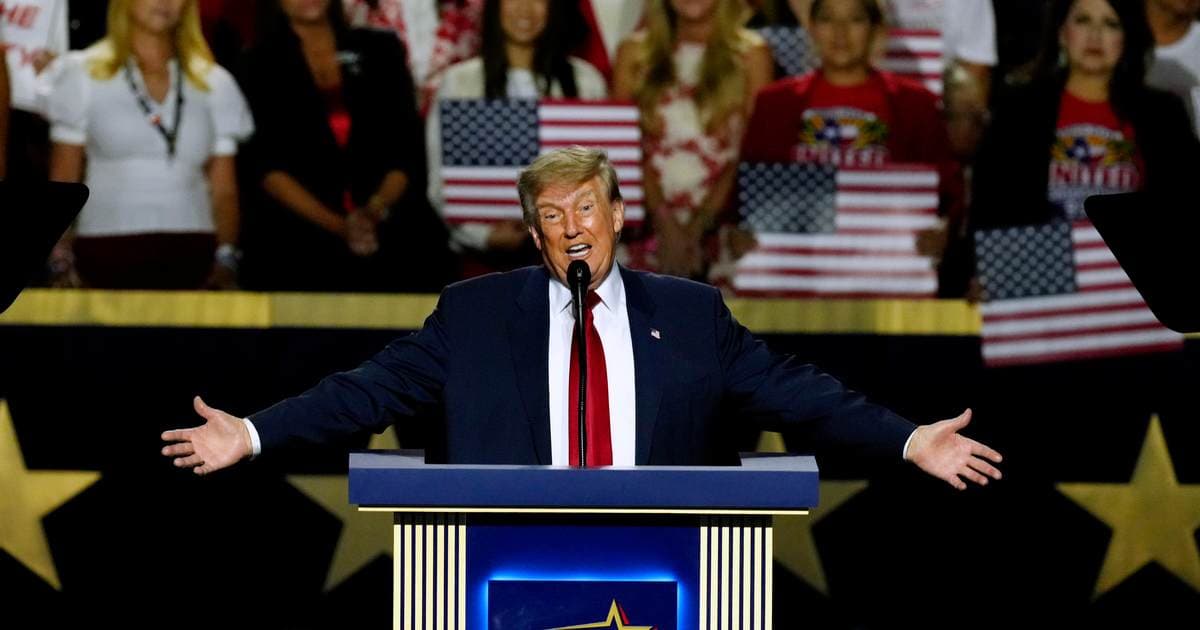
 Trump speaks with arms outstretched at a campaign rally with flag-waving supporters.
Trump picks safe red states over battleground midterm rallies
Intra-Party Split Detected
Some Republicans and strategists question whether rallying in deep-red, already-safe states is the best use of Trump's time versus competitive battleground races, while others defend it as a turnout strategy for midterms.
Left says
- •Trump's low national approval ratings make competitive battleground campaigning politically risky, so rallying loyal supporters in deep-red territory avoids exposing that weakness.
- •Rising costs, backlash to an unpopular Iran conflict, and controversy over mass deportations have eroded GOP standing even in some traditionally safe areas, forcing the party to shore up its own base rather than expand into contested ground.
- •Redistricting in states like Alabama has been used to convert competitive districts into safer Republican territory, showing the party is engineering favorable maps rather than winning voters through persuasion.
- •Focusing energy on turnout in friendly districts rather than swing states suggests a defensive midterm strategy driven by anxiety about enthusiasm gaps among Republican voters.
Right says
- •Presidential travel to red states to boost base turnout is a normal, time-tested midterm strategy and not a sign of weakness.
- •Trump's Texas visit ties campaign travel directly to tangible economic wins, including manufacturing job growth and increased truck production tied to his trade and tariff policies.
- •Competitive races in Texas, including a closely watched Senate toss-up and a gubernatorial contest, show Trump is still engaging with battleground dynamics even while visiting a reliably Republican state.
- •Rallying supporters in strong GOP districts helps maintain enthusiasm and turnout, which down-ballot Republican candidates need to protect majorities in Congress.
Common Take
High Consensus- Trump is scheduled to hold multiple rallies in Oklahoma, Alabama, Nebraska, and Texas in the weeks leading up to the midterms.
- Several of these states include districts reshaped by redistricting or containing competitive down-ballot races.
- Midterm turnout among the Republican base is viewed by both sides as a key factor in the 2026 elections.
- Presidents historically campaign in safe states during midterms to energize supporters, a practice not unique to Trump.
The Arguments
Left argues
Trump's low national approval ratings make campaigning in competitive battleground districts politically risky, so he is instead choosing safe, deep-red territory where his presence can't backfire on down-ballot candidates.
Right counters
Experts cited even in critical coverage acknowledge that presidents visiting safe states during midterms is not unprecedented; the strategy is about maximizing base turnout, not avoiding personal exposure.
Right argues
Rallying supporters in strong GOP districts like Oklahoma's 2nd and Alabama's 1st helps drive enthusiasm and turnout that down-ballot Republicans need to hold their majorities, which is a legitimate and traditional midterm tactic.
Left counters
If the GOP's own base needs this much shoring up in districts Trump won by 40-50 points, it suggests deep enthusiasm problems that a purely turnout-focused explanation doesn't fully account for.
Left argues
The redrawing of Alabama's congressional map to convert a competitive district held by a Democrat into a safely Republican one shows the party engineering favorable terrain rather than winning voters through persuasion.
Right counters
Redistricting is a legal and routine part of the political process both parties use, and Trump's rally there still supports Republican candidates in a real electoral contest, redrawn lines notwithstanding.
Right argues
Trump's Texas visit demonstrates his travel isn't purely defensive, since he's touting concrete economic wins like manufacturing job growth and tariff-driven investment while also engaging with genuinely competitive races like the Paxton-Talarico Senate toss-up.
Left counters
The fact that Texas is even considered competitive for a Senate seat in a state Trump won by 14 points in 2024 undercuts the narrative that this is simply normal red-state confidence-building rather than a sign of GOP vulnerability.
Left argues
Rising costs, backlash over an unpopular Iran conflict, and controversy over mass deportations have eroded Republican standing even in traditionally safe areas, forcing a defensive posture focused on shoring up the base rather than expanding into contested ground.
Right counters
Visiting multiple deep-red states in quick succession is consistent with a party confidently investing in turnout infrastructure everywhere, not merely retreating from swing states out of necessity.
Challenge Questions
These questions target genuine internal contradictions — meant to provoke honest reflection.
Right asks Left
“If visiting safe red states is evidence of political weakness, how do you explain that presidents of both parties have historically done exactly this during midterms without it being framed as an admission of failure?”
Left asks Right
“If this red-state travel is simply standard turnout strategy, why does it require redrawn maps and rallies in newly safened districts rather than relying on organic voter enthusiasm in districts as they existed before redistricting?”
Outlier Report
Left Fringe
Commentators like Keith Olbermann or accounts in the 'Trump is finished' online left (roughly 10-15% of the left) argue Trump's low approval makes him a liability even in red states, an extreme framing beyond mainstream Democratic messaging.
Right Fringe
MAGA-aligned commentators like Charlie Kirk or Benny Johnson (roughly 15-20% of the right) frame every Trump rally as evidence of unstoppable momentum and landslide enthusiasm, dismissing any strategic caution narrative entirely.
Noise Assessment
Moderate noise; this is a mid-tier political strategy story that generates significant partisan social media commentary but limited genuine public polling attention, with much of the framing driven by campaign operatives and pundits rather than grassroots public sentiment.
Sources (5)
Two rallies will each be in congressional districts and states that appear to favor the Republican Party in the 2026 midterm elections.
His visits come as the GOP rushes to shore up their own territory amid sky-high costs, an unpopular Iran war and some backlash to mass deportations.
The event is scheduled for Oct. 2nd in Mobile, but the plans are still subject to change, according to two people with direct knowledge of the matter.
The Republican National Committee announced Tuesday that President Trump will headline a rally in Nebraska, marking the latest stop in his upcoming swing of red states over the next week. Trump will make a stop in the city of Grand Island, located in central Nebraska. The state, known as a red stronghold, is home to…