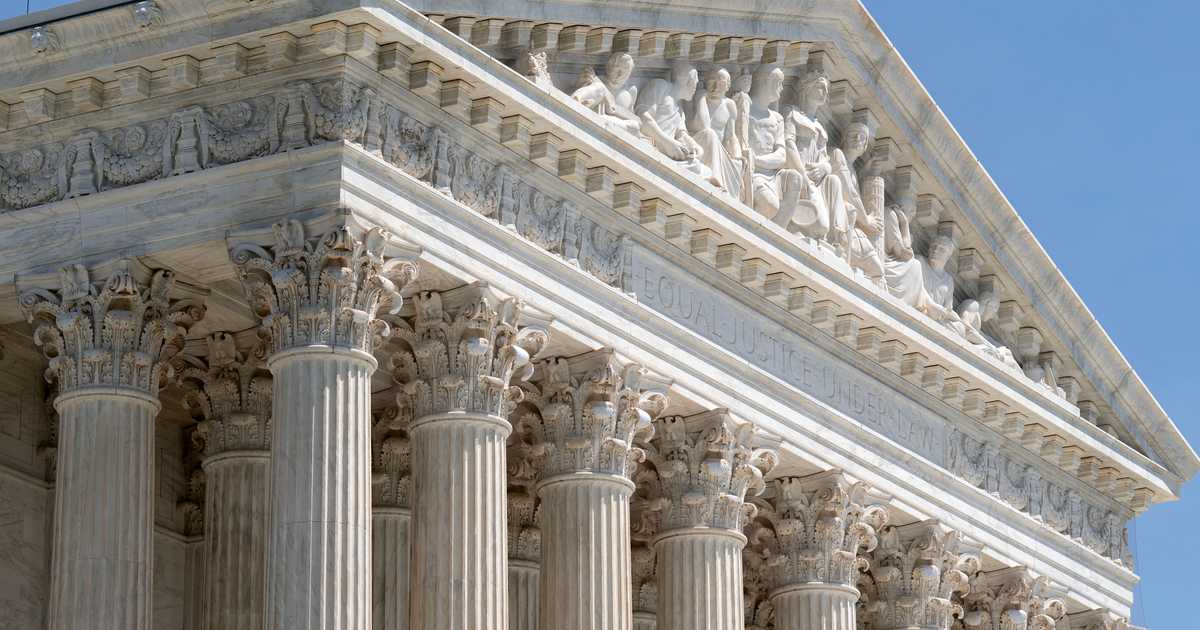
 The U.S. Supreme Court building, which issued the 7-2 ruling on mail ballots.
Supreme Court Blocks Trump's Mail Ballot Rules 7-2
Intra-Party Split Detected
Conservative justices split, with Kavanaugh joining the majority to block the rule for timing reasons while Alito and Thomas dissented, arguing USPS likely had authority to enforce it.
Left says
- •The Postal Service rule would have imposed unprecedented federal control over how states run mail-in voting, an area historically left to state discretion.
- •With ballots already going out in states like North Carolina, Alabama and Wisconsin, implementing new barcode and voter-list requirements this close to the election risked disenfranchising millions of voters.
- •The rule stemmed from a Trump executive order pushing unsubstantiated claims of mail-ballot fraud, part of a broader pattern of attempts to assert federal control over elections and sow doubt about results.
- •Voting rights groups and Democratic state officials argue the courts and Supreme Court correctly stopped an 11th-hour effort to disrupt a voting method used by nearly a third of the country.
Right says
- •The rule was framed by the administration as an election-security measure meant to verify that ballots go only to confirmed registered voters.
- •Justice Alito's dissent argues the Postal Service has broad legal authority to regulate the mail and likely had the power to enact these restrictions.
- •Alito's dissent also faults the challenging states and courts for the delays that made timely implementation impossible, arguing they shouldn't benefit from a timing problem they helped create.
- •Justice Kavanaugh's concurrence leaves open the possibility that the rule could be found lawful and applied in future elections, suggesting this is a timing defeat rather than a permanent one.
Common Take
High Consensus- The Supreme Court ruled 7-2 to block the Postal Service mail-ballot rule from taking effect for the 2026 midterms.
- Justices Alito and Thomas dissented, while Justice Kavanaugh concurred with the majority but signaled openness to the rule's legality in future cases.
- The ruling came as mail voting was already underway in several states, creating a compressed timeline for any new rule to be implemented.
- Nearly one-third of American voters rely on mail-in ballots, making the outcome consequential regardless of one's position on the rule itself.
The Arguments
Left argues
Implementing sweeping new barcode and voter-list requirements just weeks before an election, with ballots already mailed in several states, risked massive disenfranchisement and administrative chaos regardless of the rule's underlying merits.
Right counters
Alito's dissent argues the states and courts themselves created this timing problem through litigation delays, so they shouldn't be rewarded with an injunction based on a crisis they helped manufacture.
Right argues
The rule was a legitimate election-security measure to ensure ballots only go to verified registered voters, and Alito's dissent contends the Postal Service has broad statutory authority to regulate the mail, making the underlying rule likely lawful.
Left counters
Even Kavanaugh, who agreed the rule might ultimately be lawful, concluded it would be arbitrary and capricious to impose it now because state and local officials lack sufficient time to implement it before the midterms.
Left argues
Mail-in voting has historically been governed by the states, and this rule represented an unprecedented assertion of federal executive control over election administration, part of a broader pattern of efforts to centralize control over how elections are run and to cast doubt on their legitimacy.
Right counters
Framing federal coordination through the Postal Service as an authoritarian power grab ignores that the rule was aimed narrowly at ballot-list verification and barcoding, a security-focused measure well within the range of things Congress has empowered USPS to regulate about the mail.
Right argues
Kavanaugh's concurrence explicitly leaves the door open for the rule to be found lawful and applied in future elections, meaning this is a procedural, timing-based defeat rather than a repudiation of the policy's substance.
Left counters
A 7-2 vote against the administration, with even Kavanaugh refusing to let it take effect now, shows the practical and legal problems with imposing such a rule are serious, not just a matter of unlucky timing.
Left argues
Voting rights groups and election officials, including some Republicans from vote-by-mail states like Utah, warned the rule carried real risks of cutting off ballot access for legitimate voters, and the courts had ample evidence, including from a USPS whistleblower, to justify blocking it.
Right counters
The administration's stated goal, verifying ballots go only to confirmed registered voters, addresses a legitimate security interest, and bipartisan concern about implementation timing is not the same as bipartisan opposition to the policy's underlying goal.
Challenge Questions
These questions target genuine internal contradictions — meant to provoke honest reflection.
Right asks Left
“If the objection is primarily about rushed implementation rather than the rule's substance, as Kavanaugh's concurrence suggests, why do left-leaning groups describe this as a stark defeat for the policy itself rather than a temporary, timing-based delay?”
Left asks Right
“If Alito's dissent blames the states and courts for the delays that made implementation impossible, does that not implicitly concede that the timing genuinely was too rushed to protect voters, regardless of who is at fault for causing it?”
Outlier Report
Left Fringe
Groups like Democracy Defenders Fund and some Guardian commentary framing this as part of an authoritarian 'rigging' scheme represent a more alarmist ~15-20% of the left; most Democrats and voting-rights advocates focus on practical disenfranchisement risk rather than coup-style rhetoric.
Right Fringe
Commentators like Nick Sortor and some Townhall-adjacent voices claiming the ruling forces USPS to mail ballots to 'illegals and non-citizens' represent an extreme, factually unsupported framing held by roughly 15-20% of the right; most Republicans, including officials like Utah's, took a more measured view given many GOP-run vote-by-mail states opposed the rule.
Noise Assessment
High noise on social media, with viral breaking-news style posts amplifying dramatic framing (e.g., 'rigging,' 'no country anymore') far beyond what polling or elected officials' actual positions support; the substantive legal debate (timing vs. authority) is more nuanced than the online reaction suggests.
Sources (10)
The decision means a Postal Service measure that could lead to ballots not being sent to voters won’t be in effect for this November’s midterm elections.
The Trump administration had asked the justices to allow a new Postal Service plan to screen ballots just weeks before the midterm elections.
President Trump has launched a broad, governmentwide effort to take more control of state-run elections and sow doubt about the outcome.
The Supreme Court has rejected the Trump administration's request to allow mail-in voting restrictions under a U.S. Postal Service plan for the midterm general election.
The decision allows states to continue sending ballots under existing processes used by nearly one-third of voters.
<p>This live blog is now closed.</p><ul><li><p><a href="https://www.theguardian.com/us-news/2026/sep/14/supreme-court-rejects-mail-ballot-restrictions">Supreme court rejects Trump’s mail ballot restrictions for midterm elections</a></p></li><li><p><a href="https://www.theguardian.com/news/2026/feb/17/sign-up-for-the-breaking-news-us-email-to-get-newsletter-alerts-direct-to-your-inbox?utm_medium=ACQUISITIONS_STANDFIRST&utm_campaign=BN22326&utm_content=signup&utm_term=standfirst&utm_source=GUARDIAN_WEB">Sign up for the Breaking News US email</a></p></li></ul><p>Donald Trump has claimed there is a <strong>“SICK conspiracy”</strong> against artificial intelligence and data centers in response to the growing calls for greater checks on AI development.</p><p><strong>“The only control or ‘guardrails’ that AI needs is a STRONG AND SMART (High IQ!) PRESIDENT, and the U.S.A. has that, in spades!”</strong> Trump wrote on Truth Social, insisting that the administration has stopped leaders of AI companies from <strong>“doing bad, or potentially bad”</strong> things. However, he didn’t point to any concrete examples for how he has curbed possible abuse or malfeasance in the industry.</p><p>There is a SICK conspiracy going on against AI and Data Centers, and the only one that is happy about it is China … We are leading China, and all others, and will continue to do so. Conspiracy Theorists, Treasonists, Traitors, and Leakers, BEWARE!</p> <a href="https://www.theguardian.com/us-news/live/2026/sep/14/donald-trump-mail-in-voting-supreme-court-blocked-ukraine-oil-diplomat-latest-news-updates">Continue reading...</a>
<p>Decision allows states to send ballots under process followed for years even as president tried to limit system</p><p>The supreme court on Monday rejected Donald Trump’s mail ballot restrictions for now, capping a flurry of last-minute legal action with voting in the midterm elections already underway.</p><p>The decision allows states to continue sending out mail ballots under the same processes they have used for years.</p> <a href="https://www.theguardian.com/us-news/2026/sep/14/supreme-court-rejects-mail-ballot-restrictions">Continue reading...</a>
The Supreme Court refused to clear the way for President Trump’s mail-in voting plan for the midterms on Monday over the dissents of two conservative justices, keeping intact a judge’s block that declared the plan unlawful. It’s the third time the Trump administration brought the plan to the high court’s emergency docket after groups have blocked the effort.   Previously, the…
The Trump administration had said the plan was necessary to protect against voter fraud. States and voting rights groups said it could inject chaos into contests.