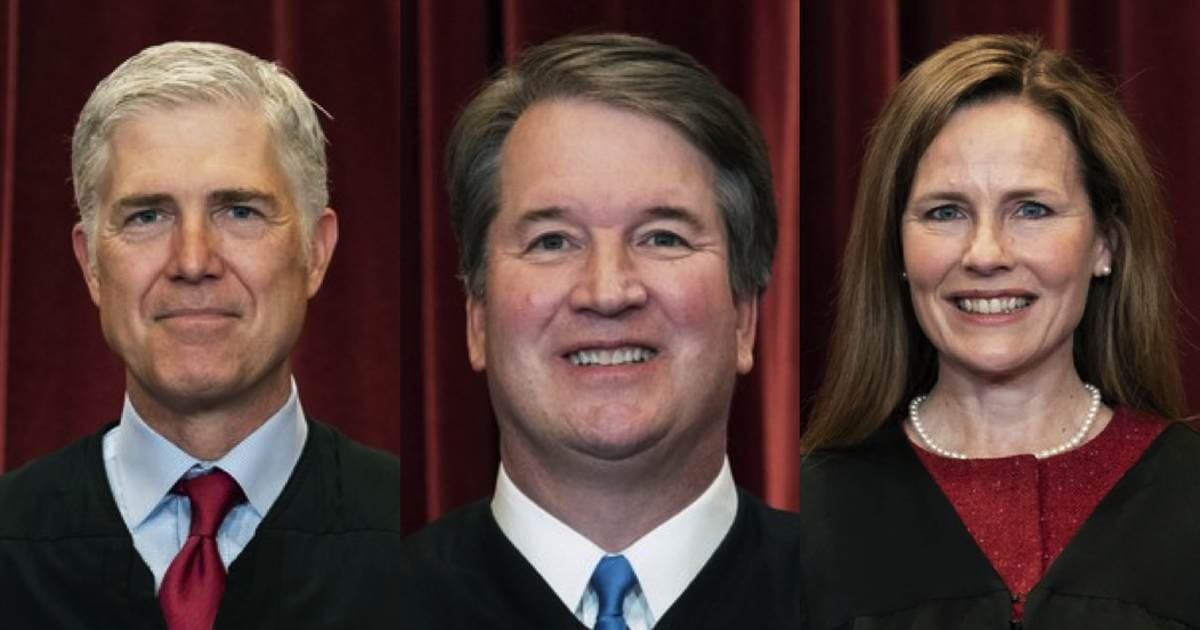
Trump Says He Regrets Picking Gorsuch, Kavanaugh, Barrett
Intra-Party Split Detected
Trump and some conservative commentary criticize his own Supreme Court nominees for insufficient loyalty, while other conservatives note these justices have delivered major conservative wins on abortion, guns, and affirmative action, exposing tension between loyalty-based and principle-based conservatism.
Left says
- •The justices' willingness to rule against Trump on issues like the USPS mail-in ballot rule reflects judicial independence working as intended, not disloyalty.
- •Trump's explicit admiration for the liberal justices' bloc voting and 'loyalty' to the presidents who appointed them reveals he views the Court as a political tool rather than an independent branch.
- •Trump's public pressure campaign against sitting justices, including calling them 'a shell of their original selves,' undermines judicial independence and the separation of powers.
- •Trump's frustration stems largely from rulings on birthright citizenship and tariffs, decisions rooted in constitutional interpretation rather than personal favoritism.
Right says
- •Trump's comments reflect legitimate frustration that justices he expected to be reliably conservative have sided against his administration on major policy fights like tariffs and birthright citizenship.
- •Trump argues that birthright citizenship rulings have created a costly 'industry' exploiting the current legal interpretation, costing the country financially.
- •Trump contrasts the inconsistency of his nominees with what he describes as the unwavering, bloc-like loyalty of the liberal justices to the presidents who appointed them.
- •Trump clarifies he does not necessarily want blind loyalty from justices, distinguishing his comments as criticism of outcomes rather than a demand for personal fealty.
Common Take
High Consensus- Trump nominated Gorsuch, Kavanaugh, and Barrett during his first term and now expresses regret over some of their rulings.
- The named rulings involve high-profile issues including birthright citizenship, tariffs, and mail-in ballot regulations.
- Trump made these remarks in an interview with Time magazine published in late 2026.
- Trump has publicly criticized the Supreme Court, including via Truth Social, when decisions have gone against his administration.
The Arguments
Left argues
The justices' willingness to rule against Trump on issues like the USPS mail-in ballot rule demonstrates judicial independence functioning correctly, with justices applying law rather than personal loyalty to the president who appointed them.
Right counters
Trump's frustration isn't that they exercised independence per se, but that their rulings on birthright citizenship and tariffs have produced costly, real-world consequences he believes are constitutionally wrong, not merely a complaint about independence itself.
Right argues
Trump's comments reflect legitimate policy frustration that justices he expected to interpret the Constitution in a conservative direction have instead ruled against his administration on major issues like tariffs and birthright citizenship, costing the country financially by his account.
Left counters
Framing disagreement with the administration as justices being insufficiently 'loyal' reveals Trump evaluates judicial legitimacy by outcomes for him personally rather than by constitutional reasoning, which is precisely the politicization critics warn against.
Left argues
Trump's explicit admiration for the liberal justices' bloc voting and consistent 'loyalty' to the presidents who appointed them exposes a view of the Court as a political extension of the executive rather than an independent check on it.
Right counters
Trump directly clarified he doesn't necessarily want blind loyalty, framing his comments as criticism of specific rulings' consequences rather than a demand that justices functionally serve the president.
Right argues
Trump contrasts what he sees as inconsistency among his nominees with the unwavering bloc voting of liberal justices, arguing this reveals a legitimate asymmetry in how reliably each side's appointees adhere to their presumed judicial philosophy.
Left counters
Treating consistent liberal bloc voting as 'loyalty' to Obama or Biden, rather than as adherence to a coherent judicial philosophy, mischaracterizes the nature of judicial decision-making on both sides and conveniently ignores conservative justices' own consistent rulings favorable to Trump in other major cases.
Left argues
Trump's public pressure campaign, including calling sitting justices 'a shell of their original selves,' represents an attempt to intimidate the judiciary into favorable rulings, undermining the separation of powers that protects judicial independence.
Right counters
Presidents criticizing Supreme Court rulings is a longstanding American political tradition, and vocal disagreement with specific decisions doesn't constitute coercion, especially since the justices in question have ruled for Trump on other significant cases like abortion and gun rights.
Challenge Questions
These questions target genuine internal contradictions — meant to provoke honest reflection.
Right asks Left
“If judicial independence is being celebrated when justices rule against Trump, does the same principle apply when conservative justices ruled in Trump's favor on other cases, or is independence only praised when it produces outcomes the left favors?”
Left asks Right
“If Trump insists he doesn't want blind loyalty from justices, why does he simultaneously praise liberal justices specifically for their unwavering bloc loyalty to the presidents who appointed them, and criticize his own nominees for failing to exhibit that same trait?”
Outlier Report
Left Fringe
Commentators like those at MSNBC (e.g., Rachel Maddow) and some Democratic officials may push narratives that this proves the Court is fundamentally broken or illegitimate, a more extreme framing than mainstream 'judicial independence' concerns. This represents maybe 15-20% of the left.
Right Fringe
Figures like Steve Bannon or some MAGA-aligned commentators (e.g., on War Room) may go further than Trump, suggesting these justices should face impeachment or court-packing retaliation, representing a more aggressive stance than most conservatives who simply share policy frustration. This is roughly 10-15% of the right.
Noise Assessment
High noise ratio — this story generates significant social media amplification and clipped soundbites (e.g., the 'loyalty' comments) that get stripped of context, but actual public opinion is more measured and splits along existing views of Trump and the judiciary rather than reacting fresh to these specific comments.
Sources (5)
President Donald Trump said in a new interview that he regrets nominating Justices Neil Gorsuch, Brett Kavanaugh, and Amy Coney Barrett to the Supreme Court, faulting them for ruling against his policies.
President Trump revealed in an interview published Thursday that he regrets nominating conservative Justices Neil Gorsuch, Brett Kavanaugh, and Amy Coney Barrett to the Supreme Court.  “Yeah. Yeah. What can I do? I put them in,” Trump told Time magazine when asked whether he regretted nominating the three justices to the high court.  “They voted…
"What can I do? I put them in," he also said.